


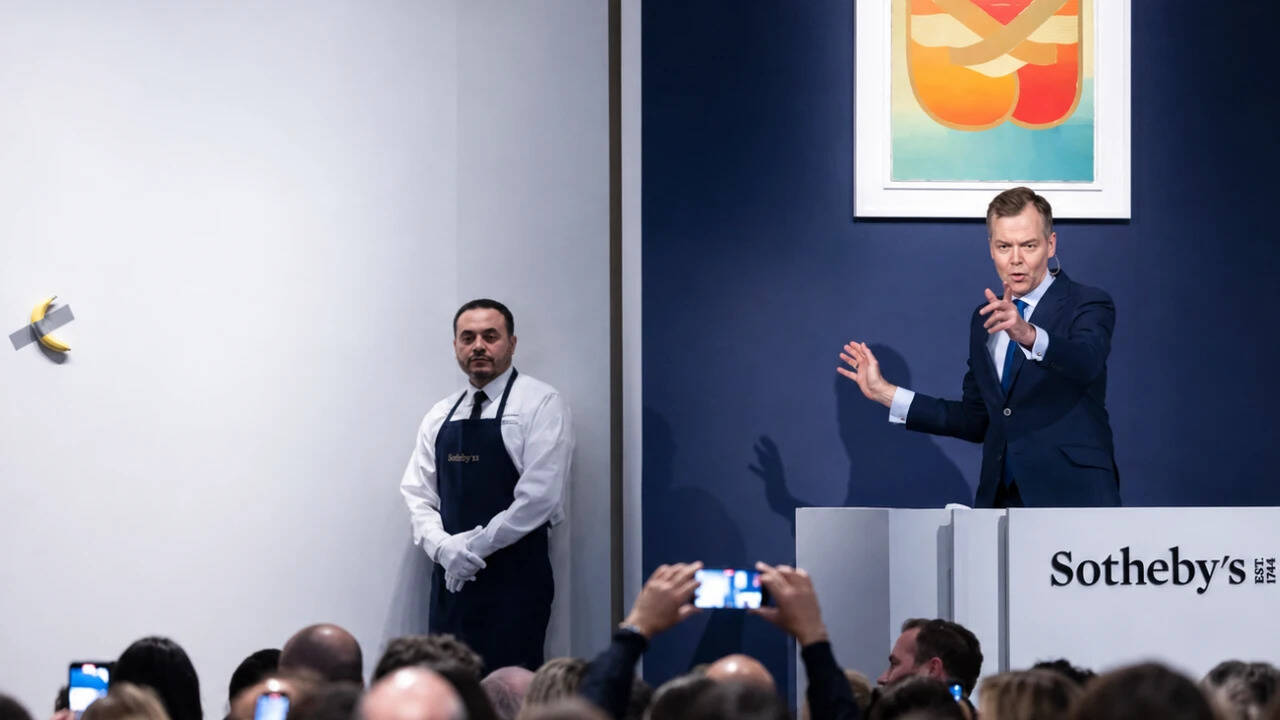
Banana art sells for $6.24 million, sparking debate on modern art pricing
Translated from English, summarized and contextualized by DistantNews.
At a glance
In-depth
Sources not specified
Context piece
- An artwork consisting of a banana duct-taped to a wall sold for $6.24 million at a Sotheby's auction.
- The value of the conceptual piece, titled "Comedian," lies in its theatrics, with the fruit intended to rot and be replaced.
- The article questions the pricing of modern art, referencing Jackson Pollock's abstract expressionism and scientific attempts to validate its value.
A banana duct-taped to a wall fetched a staggering $6.24 million at a Sotheby's auction, highlighting the often-baffling world of contemporary art pricing. Maurizio Cattelan's "Comedian" was not about the fruit itself, but the concept and the ensuing spectacle. The original banana rotted and was eaten, and the buyer received a certificate of authenticity and instructions to tape up a new banana.
Its value lies in the theatrics.
The artwork's value is rooted in its "theatrics," as the article puts it. This raises questions about what constitutes art and why seemingly simple creations command such high prices. The piece has been eaten multiple times, including by the new owner on camera shortly after purchase, further emphasizing its conceptual nature.
The fruit rotted within days, as fruit does.
To explore this phenomenon, the article delves into the case of Jackson Pollock, whose abstract expressionist works, initially perceived by some as mere "uncontrolled splashes," were later analyzed by physicists. Studies attempted to find scientific validation for his art's value through fractal patterns, suggesting a hidden complexity. However, subsequent research cast doubt on these findings, complicating the notion that science could definitively justify the market's valuation of such art.
What actually changed hands was a certificate of authenticity and a laminated instruction sheet on how to tape up the next banana.
The piece ultimately questions the disconnect between classical art and modern conceptual pieces, pondering why an "uneducated" eye might see a toddler's creation while the market assigns millions. It suggests that the value often lies not in the physical object, but in the idea, the artist's reputation, and the market's willingness to engage with the absurdity.
For the longest time, to an ‘uneducated’ eye, and sometimes even an ‘educated’ one, his art seemed to be just uncontrolled splashes framed on a wall.
DistantNews Editorial
Originally published by Times of India in English. Translated, summarized, and contextualized by our editorial team with added local perspective. Read our editorial standards.
More Stories



From Our Blog

What Press Freedom Means for the News You Read

What Gets Lost (and Found) When News Is Translated

The Critical Role of Diaspora Media in Global News

What Travellers Should Know About Countries with Restricted Press

A Digital Nomad's Guide to Following Local News
