


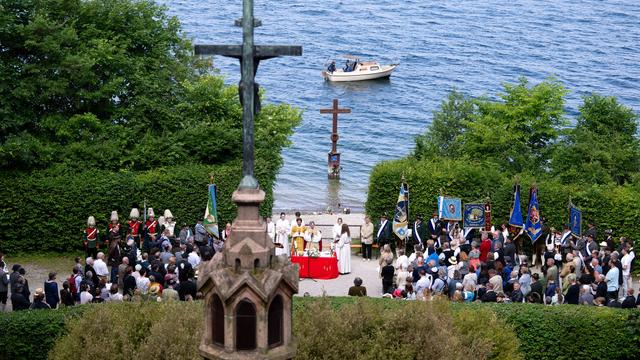
Bavaria commemorates King Ludwig II 140 years after his death
Translated from German, summarized and contextualized by DistantNews.
At a glance
News
From a news agency
Outcome reported
- Around 1,000 royalists and monarch fans gathered at Lake Starnberg to commemorate King Ludwig II 140 years after his death.
- The event included a church service, laying of flowers at a memorial cross, and the singing of the Bavarian anthem.
- Bavarian Minister-President Markus Söder attended the unveiling of a new monument to Ludwig II in Munich, highlighting his contributions to art and science.
Thousands of royalists and monarch fans gathered at Lake Starnberg to commemorate King Ludwig II, Bavaria's "Fairy Tale King," 140 years after his mysterious death. The monarch, known for commissioning iconic castles like Neuschwanstein, Linderhof, and Herrenchiemsee, was found dead in the lake on June 13, 1886, at the age of 40.
Approximately 1,000 Ludwig fans, many dressed in traditional Bavarian attire or uniforms, participated in a church service near the site of his death. They laid flowers at a memorial cross on the lake shore, honoring the king. The event, held under clear skies, concluded with the singing of the Bavarian anthem.
In Munich, Bavarian Minister-President Markus Söder attended the unveiling of a new monument dedicated to Ludwig II. Söder emphasized the king's dedication not only to art but also to science, noting his role in founding the Technical University of Munich, now a leading European institution. "We resolutely continue this Wittelsbach policy of tradition and progress to this day," Söder stated, drawing a parallel between the historical policies and current governance.
Bavaria is honoring its most famous monarch through various events this weekend. The unveiling of the Munich monument and the memorial service in Berg am Starnberger See are central to the commemorations. Ludwig II's legacy as the builder of famous castles continues to shape Bavaria's image, attracting hundreds of thousands of visitors to his palaces annually.
DistantNews Editorial
Originally published by Die Zeit in German. Translated, summarized, and contextualized by our editorial team with added local perspective. Read our editorial standards.
More Stories

From Our Blog

What Gets Lost (and Found) When News Is Translated

How the Same Story Looks Different in Different Countries

The Critical Role of Diaspora Media in Global News

What Travellers Should Know About Countries with Restricted Press

A Digital Nomad's Guide to Following Local News
