


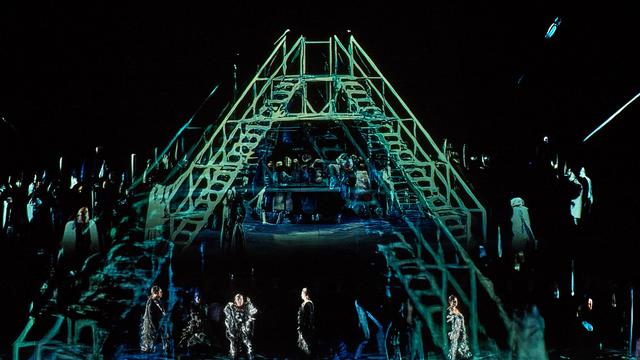
Bayreuth Festival's AI 'Ring' production draws boos from audience
Translated from German, summarized and contextualized by DistantNews.
At a glance
News
From a news agency
Context piece
- The Bayreuth Festival's 150th anniversary featured a "Ring of the Nibelung" tetralogy staged with artificial intelligence.
- The audience reacted negatively to the AI-generated visuals, with loud boos and whistles directed at the production team.
- Performers, the choir, and conductor Christian Thielemann, however, received enthusiastic applause.
The Bayreuth Festival's 150th-anniversary celebration was marked by an experimental staging of Richard Wagner's "Ring of the Nibelung" tetralogy, utilizing artificial intelligence for its visual elements. The final part, "Götterdämmerung," concluded the AI-driven production, which presented a "hardly comprehensible collage of images" projected onto the stage.
A hardly comprehensible collage of images accompanied "Götterdämmerung" at the Bayreuth Festival.
The audience's reception to the AI-generated backdrop was overwhelmingly negative. As curator Marcus Lobbes and his team appeared on stage, they were met with loud boos and whistles. This discontent, however, was not directed at the entire performance. Soloists, the choir, and particularly musical director Christian Thielemann were met with jubilant applause, highlighting a clear distinction in audience appreciation between the musical and visual aspects of the production.
The displeasure from the auditorium was not directed at the entire performance: soloists, choir and especially the musical director, Christian Thielemann, were cheered and heartily applauded.
The AI, guided by a pre-selected image database from Lobbes and his team, generated visuals that included scenes from previous "Ring" stagings, historical motifs, and even seemingly random images like former Chancellor Helmut Kohl and the Twin Towers after the 9/11 attacks. While dramatic color plays were sometimes effective, the overall effect often left the audience puzzled, with criticisms focusing on a lack of clear direction and the visuals being described as a "picture salad."
I miss a bit of props. A sword would be nice, a spear, an anvil, some form of camouflage.
Among the attendees was entertainer Harald Schmidt, a self-proclaimed Wagner enthusiast. Schmidt offered a more measured critique, noting that the visuals in "Götterdämmerung" were calmer than in "Das Rheingold" and suggested the AI might be learning. However, he expressed a longing for traditional stage props, like a sword or anvil, and stated that while it was an experiment, audiences ultimately prefer "a real staging, when it is played."
I believe that one is then happy when it is a real staging again, when it is played.
DistantNews Editorial
Originally published by Die Zeit in German. Translated, summarized, and contextualized by our editorial team with added local perspective. Read our editorial standards.
More Stories

From Our Blog

What Gets Lost (and Found) When News Is Translated

How the Same Story Looks Different in Different Countries

The Critical Role of Diaspora Media in Global News

What Travellers Should Know About Countries with Restricted Press

A Digital Nomad's Guide to Following Local News
