


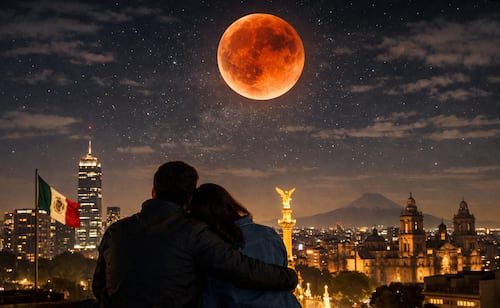
 Image: Imagen generada con IA
Best spots in Mexico City to watch August's lunar eclipse
Translated from Spanish and summarized by DistantNews. Read the original for the full story.
At a glance
In-depth
Sources not specified
Outcome reported
- Mexico City residents can view a partial lunar eclipse on August 27, 2026, with 96% coverage, visible from evening into early morning.
- Several institutions, including the Luis Enrique Erro Planetarium and Universum, are offering free activities and telescope viewings.
- Open spaces like Chapultepec Park and natural parks outside the city offer optimal viewing conditions away from light pollution.
Mexico City is preparing to host a significant astronomical event as a partial lunar eclipse, covering 96% of the moon, is set to occur on the evening of Thursday, August 27, 2026. The phenomenon will extend into the early hours of Friday, August 28, offering skygazers ample opportunity to witness the celestial display.
Thousands of enthusiasts in the capital are seeking ideal locations to observe the eclipse. The National Aeronautics and Space Administration (NASA) explains that lunar eclipses happen when the Moon partially passes through Earth's umbra due to an imperfect alignment of the Sun, Earth, and Moon. The eclipse is expected to begin at 7:23 PM, reach its peak at 10:12 PM, and conclude at 1:01 AM.
To accommodate the public's interest, various institutions are organizing viewing events. The Luis Enrique Erro Planetarium will provide free telescope access and educational activities. Universum, the science museum of UNAM, will host observation sessions and talks in Ciudad Universitaria. Additionally, open areas within Bosque de Chapultepec, such as the castle esplanade and the Audiorama terrace, offer clear vantage points.
For those seeking to escape the city's light pollution, the Planetario de Chimalhuacán and natural parks like Desierto de los Leones and Cumbres del Ajusco are recommended. Experts advise that, unlike solar eclipses, lunar eclipses do not require special filters or protective eyewear. The event promises to be a captivating spectacle for residents across the Americas and parts of Europe.
About this summary
Originally published by El Universal in Spanish. Translated, summarized, and contextualized automatically by DistantNews, with a note on how the source frames the story. Not individually reviewed before publishing. How this works.
More Stories

From Our Blog

What Press Freedom Means for the News You Read

What Gets Lost (and Found) When News Is Translated

The Critical Role of Diaspora Media in Global News

What Travellers Should Know About Countries with Restricted Press

A Digital Nomad's Guide to Following Local News
