

Bird nests made from fiber-optic cables reveal war's impact on Ukraine's environment
Translated from English, summarized and contextualized by DistantNews.
At a glance
News
Named sources
Context piece
- Bird nests made from discarded fiber-optic cables have been found near Ukraine's front lines, illustrating the war's environmental impact.
- Ukrainian and Russian troops use these cables to guide drones, leaving them tangled in trees and scattered across the landscape.
- Researchers are studying the nests to understand how birds are adapting to the conflict and its material remnants.
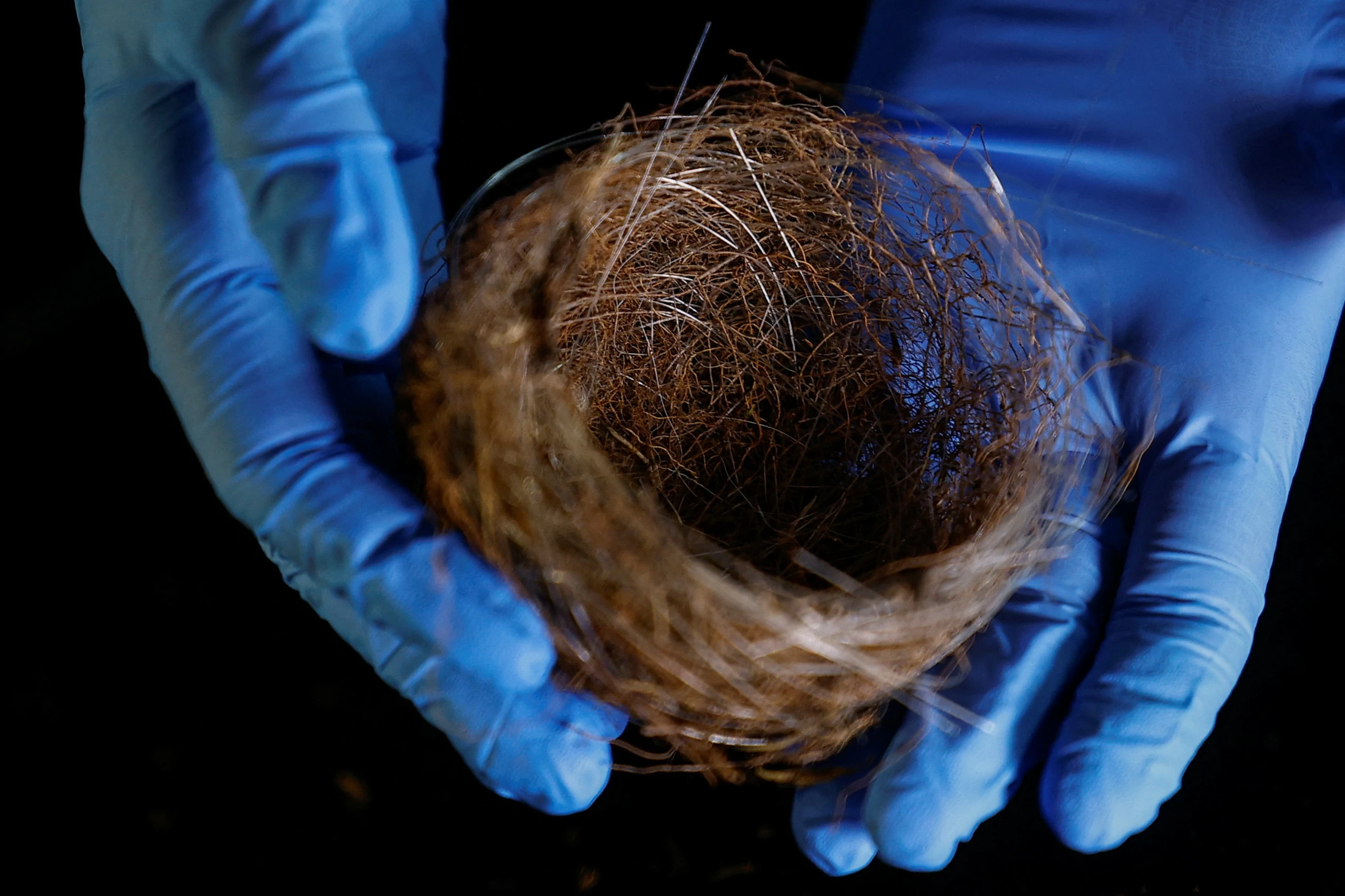
The ongoing conflict in Ukraine is reshaping not only the landscape but also the natural environment, as evidenced by bird nests woven from discarded fiber-optic cables. These delicate structures, found near the front lines, highlight the pervasive impact of the war on wildlife.
Objects such as bird nests with fragments of optic fibre demonstrate the change in the nature of war.
Ultra-thin fiber-optic cables, essential for guiding aerial attack drones used by both Ukrainian and Russian forces, stretch for miles along the 1,200-km front line. These cables, often left tangled in trees or scattered across fields, have become an unlikely material for birds constructing their nests.
Yana Hrynko, a senior researcher at Kyiv's War Museum, cautiously examined two such nests sent from the front line. She noted that the nests, primarily composed of dry grass and fiber-optic cable, are tightly twisted. Hrynko stated that objects like these nests, containing fragments of optic fiber, demonstrate the changing nature of warfare.
I have never seen nests like this before - and I have seen many, many bird nests.
Biologists like Auke-Florian Hiemstra in the Netherlands are now studying these nests. While the exact bird species responsible remain unknown, researchers plan to look for DNA traces within the nests to identify them. Hiemstra suggests the impact on birds could be mixed, potentially offering stronger nest materials but also posing risks of entanglement. The documentation of these nests serves as a stark reminder of the war's environmental consequences in Ukraine.
And by documenting this nest, we're also documenting the impact of war on nature in Ukraine.
DistantNews Editorial
Originally published by Gulf Today in English. Translated, summarized, and contextualized by our editorial team with added local perspective. Read our editorial standards.
More Stories


From Our Blog

What Gets Lost (and Found) When News Is Translated

The Critical Role of Diaspora Media in Global News

What Travellers Should Know About Countries with Restricted Press

A Digital Nomad's Guide to Following Local News

How the Same Story Looks Different in Different Countries
