


Bornean orangutan faces peril amid Kalimantan's forest fires
Translated from Indonesian, summarized and contextualized by DistantNews.
At a glance
News
Sources not specified
Context piece
- Indonesia's Kalimantan region faces severe forest and land fires (karhutla), threatening not only humans but also wildlife, particularly the endemic Bornean orangutan.
- The Bornean orangutan population has declined by 80% in less than 50 years, with current estimates around 57,350 individuals across three subspecies.
- Fire hotspots are increasingly encroaching on orangutan habitats, especially in Central and West Kalimantan, raising concerns about the impact of smoke on these animals.
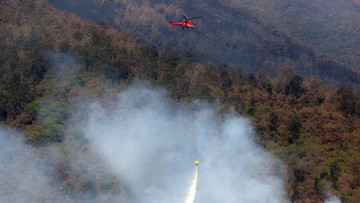
Forest and land fires raging across Indonesia's Kalimantan region pose a grave threat to wildlife, including the critically endangered Bornean orangutan (Pongo pygmaeus). This Indonesian endemic species, with an estimated population of 57,350 individuals, has seen its numbers plummet by 80% in under five decades, a stark decline from an estimated 288,500 in 1973.
The Bornean orangutan population is divided into three subspecies: Pongo pygmaeus wurmbii, with approximately 38,200 individuals in Central and West Kalimantan; Pongo pygmaeus pygmaeus, numbering around 4,520 in West Kalimantan and Sarawak, Malaysia; and Pongo pygmaeus morio, with roughly 14,630 individuals in East Kalimantan, Indonesia, and Sabah, Malaysia. The threat of fires to the Pongo pygmaeus morio subspecies and its habitat was already highlighted in a 2016 study.
As of August 20, the National Disaster Management Agency (BNPB) reported 1,487 hotspots across Kalimantan, with Central Kalimantan having the highest concentration at 767, followed by West Kalimantan with 560. These fire hotspots are increasingly nearing orangutan habitats, which are typically found in lowland areas. "In West Kalimantan it's already happening, and in Central Kalimantan it's also starting to approach population centers like near Sebangau National Park, in the Pulang Pisau area, these are areas that also have orangutans, and quite large ones," stated Jamartin Sihite, CEO of the Borneo Orangutan Survival (BOS) Foundation.
Beyond the immediate danger of fire, the pervasive smoke presents a significant challenge. While humans can mitigate exposure with masks, orangutans and their environment have no such recourse. Sihite explained that the smoke from these fires has a detrimental effect on orangutans and their living spaces, compounding the threats they face.
In West Kalimantan it's already happening, and in Central Kalimantan it's also starting to approach population centers like near Sebangau National Park, in the Pulang Pisau area, these are areas that also have orangutans, and quite large ones.
DistantNews Editorial
Originally published by CNN Indonesia in Indonesian. Translated, summarized, and contextualized by our editorial team with added local perspective. Read our editorial standards.
More Stories


From Our Blog

What Gets Lost (and Found) When News Is Translated

The Critical Role of Diaspora Media in Global News

What Travellers Should Know About Countries with Restricted Press

A Digital Nomad's Guide to Following Local News

How the Same Story Looks Different in Different Countries
