


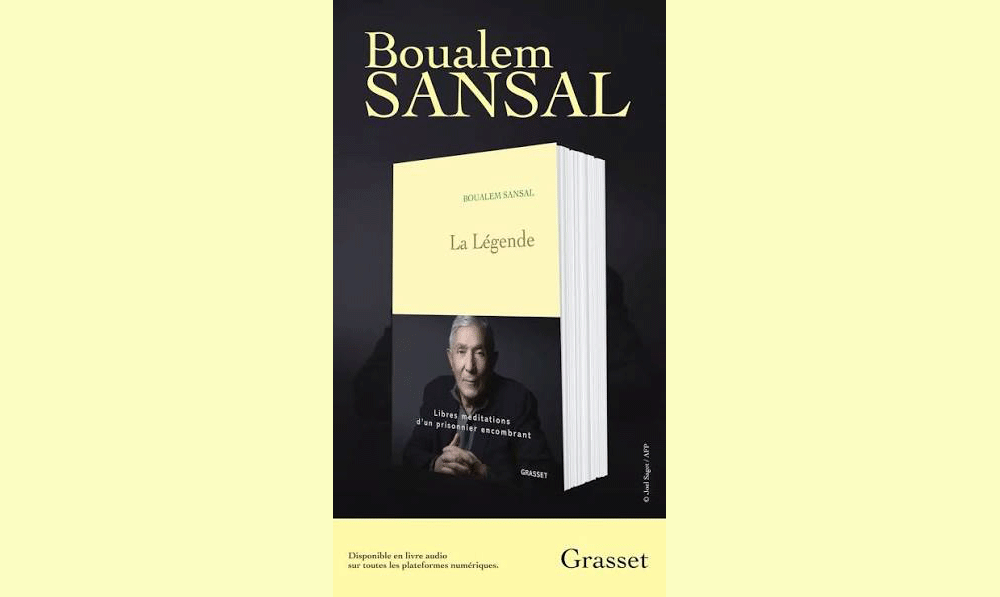
Boualem Sansal's Latest Work: Divagation and Autobiographical Overbidding
Translated from French, summarized and contextualized by DistantNews.
At a glance
Analysis
Sources not specified
Context piece
- Boualem Sansal's new book, presented as a testimony of detention, is criticized for its excessive autobiographical embellishments and ideological shifts.
- The review highlights inconsistencies in Sansal's account, such as mixing currency and fabricating details like national denaturalization and expulsion.
- The author questions Sansal's claims of innocence and his purported "Hebrew" affiliations, suggesting they are used to portray himself as a victim.
Boualem Sansal's latest book, released today, is being met with sharp criticism for deviating significantly from factual autobiography into what reviewers describe as "divagation and autobiographical overbidding." While the work purports to offer a raw account of detention and injustice, the review argues that the text quickly becomes saturated with hyperbole, reconstructions, and ideological distortions.
My trial lasted five minutes: five years in prison, a huge fine, five hundred thousand pesos, national opprobrium, seizure of our personal belongings, loss of nationality and express expulsion from the country.
The review points to specific passages where Sansal's narrative appears to falter. For instance, a quote detailing a five-minute trial leading to five years in prison, a hefty fine, national opprobrium, seizure of property, denaturalization, and expulsion is flagged for inconsistencies. The reviewer notes Sansal's use of "pesos" instead of Algerian dinars and asserts that denaturalization and expulsion were never actually pronounced.
And I had said nothing, done nothing – except talk to myself at length, without any malice.
Further questioning Sansal's credibility, the review highlights his claim of absolute innocence as vague and his use of the phrase "national opprobrium" as a theatrical cliché. The reviewer suggests that the dramatization undermines the testimony's authenticity, especially when details and context surrounding the accusation are omitted, rendering the justification for such a severe sentence absurd. The author's self-portrayal as an intellectual martyr, lacking proof, is also called into question.
They condemned me to shame, to a form of symbolic deportation, highly anti-Semitic, to punish me for my unnatural Hebrew affiliations.
The critique intensifies regarding Sansal's assertion of being condemned for "highly anti-Semitic, unnatural Hebrew affiliations." The reviewer finds this claim particularly ironic, stating Sansal has no Jewish heritage and is fabricating a "fantasmatic filiation" to play the victim. The use of terms like "Hebrew" is deemed vague and exotic, an attempt to adopt an identity he does not possess. The review also notes Sansal's past references to "invisible Tsahal" and an improbable Jewish connection in his 2011 novel "Rue Darwin," suggesting a pattern of using such elements to construct a narrative of victimhood.
I salute, in passing, the 'invisible Tsahal' (p. 61), that army of crimes against humanity, which, according to him, systematically crushed the Arab armies.
DistantNews Editorial
Originally published by El Watan in French. Translated, summarized, and contextualized by our editorial team with added local perspective. Read our editorial standards.
More Stories



From Our Blog

What Gets Lost (and Found) When News Is Translated

The Critical Role of Diaspora Media in Global News

What Travellers Should Know About Countries with Restricted Press

A Digital Nomad's Guide to Following Local News

How the Same Story Looks Different in Different Countries
