


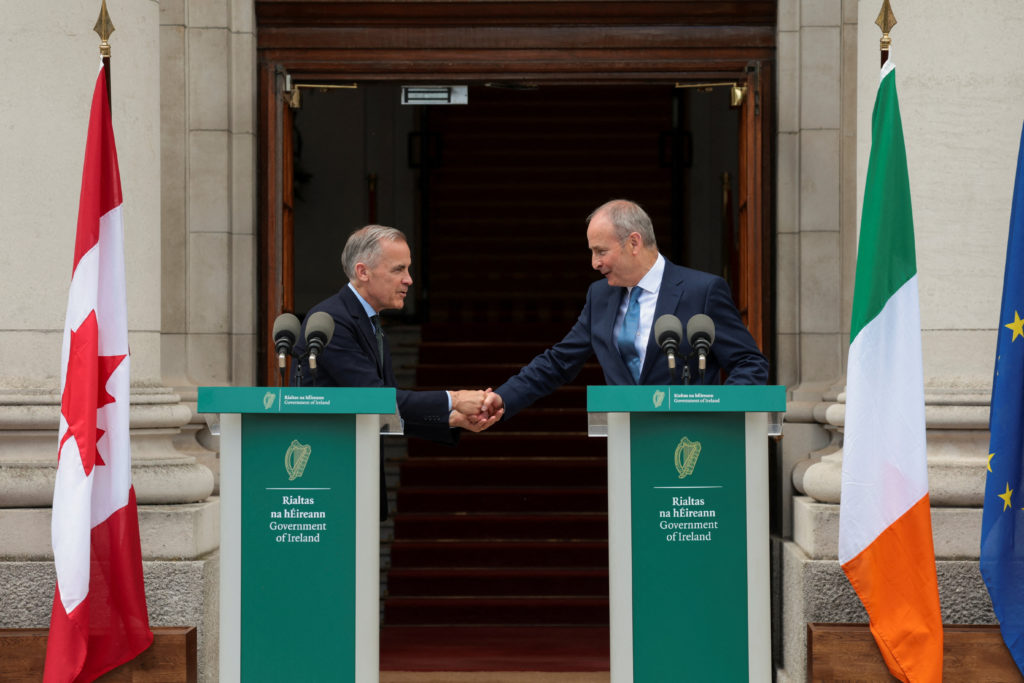
Canada's Carney says middle-power countries shouldn't compete for favor with the U.S.
Summarized and contextualized by DistantNews.
At a glance
News
Named sources
Context piece
- Canadian Prime Minister Mark Carney urged middle-power nations to unite rather than compete for U.S. favor.
- Carney highlighted the combined economic and demographic strength of Canada and the European Union.
- He spoke in Dublin ahead of the G7 summit, advocating for a "third path" in global politics.
Canadian Prime Minister Mark Carney is advocating for middle-power countries to forge their own path on the global stage, rather than seeking favor with superpowers like the United States.
Speaking in Dublin, Carney emphasized the significant collective strength of nations like Canada and the European Union. He pointed out their combined population is more than double that of the U.S., with a comparable economy and a defense budget twice that of China's. Carney argued that by partnering, smaller nations can amplify their influence.
In a world of great power rivalry, middle powers have a choice, to compete for favor or to combine to create a third path with impact
"In a world of great power rivalry, middle powers have a choice, to compete for favor or to combine to create a third path with impact," Carney stated at Trinity College. He drew parallels to his earlier remarks at the World Economic Forum in Davos, where he criticized coercion by major powers.
Carney's comments come as he prepares for the G7 summit in France. He met with Irish Taoiseach Micheál Martin and French President Emmanuel Macron ahead of the meeting. Carney described Canada and Europe as a "force for good," safeguarding shared values and transforming cooperation, particularly through initiatives like the EU's defense procurement program.
The new world order will be built starting with Europe. Canada is the most European of non-European countries. We are transforming our cooperation with Europe.
DistantNews Editorial
Originally published by PBS NewsHour. Summarized and contextualized by our editorial team with added local perspective. Read our editorial standards.
More Stories


From Our Blog

How the Same Story Looks Different in Different Countries

What Gets Lost (and Found) When News Is Translated

The Critical Role of Diaspora Media in Global News

What Travellers Should Know About Countries with Restricted Press

A Digital Nomad's Guide to Following Local News
