


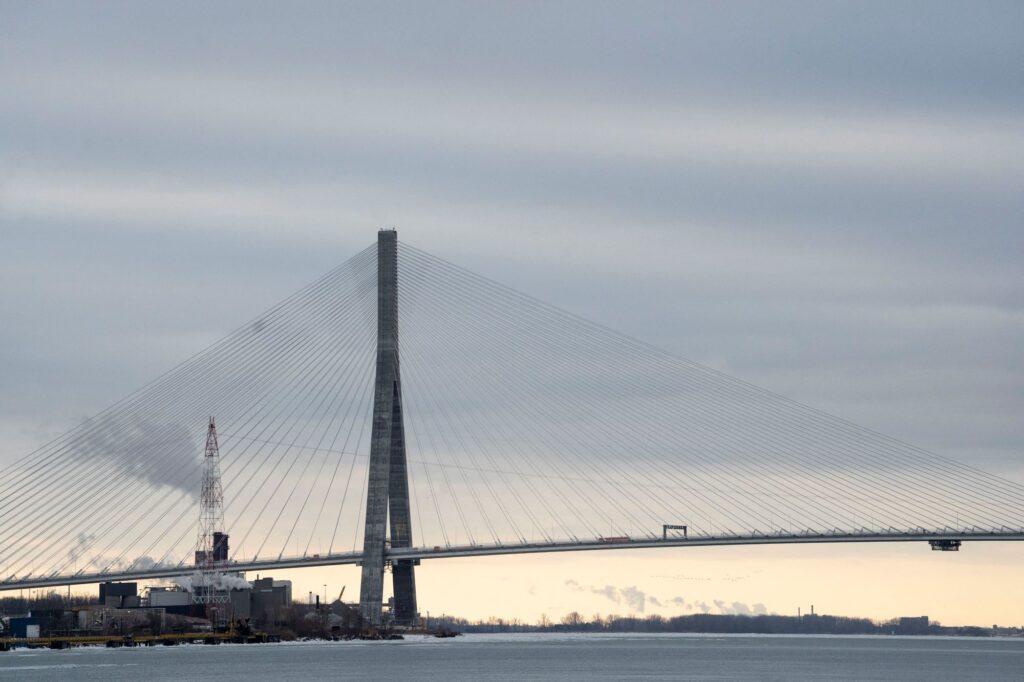
Canada Won't Share Bridge Tolls With U.S. Until Costs Recovered
Translated from Malay, summarized and contextualized by DistantNews.
At a glance
News
Named sources
Context piece
- Canada will not share toll revenue from the new Gordie Howe International Bridge with the United States until its initial investment costs are recovered.
- Prime Minister Mark Carney stated that the 2012 agreement allows Canada to collect all tolls until the bridge is paid off.
- The bridge opening has been delayed, increasing tensions with the U.S. amid ongoing trade negotiations and U.S. criticism of Canada's wildfire management.
Canada will not share toll revenue from the new Gordie Howe International Bridge with the United States until its initial investment costs are recovered, Prime Minister Mark Carney asserted. The bridge, a C$4.7 billion (RM19 billion) project connecting Windsor, Ontario, with Detroit, Michigan, has seen its opening delayed, fueling economic tensions between the two nations as they pursue a new trade agreement.
Carney reiterated that the foundational agreement with Michigan, dating back to 2012, grants Canada the right to collect all tolls until the bridge's construction costs are recouped. "Any sharing of toll revenue will not happen until all debt is paid off," he stated. He added that after operational costs like maintenance and snow removal are deducted, Canada will share net revenue with the U.S. within the first 15 years of the bridge's operation.
Any sharing of toll revenue will not happen until all debt is paid off.
"We anticipate that after accounting for these costs, the net revenue for the first few years will be small. When revenue sharing begins, all portions received by the U.S. government will be reinvested in economic development," Carney explained. Details of the agreement between Canada and the U.S. have not been publicly disclosed. However, two sources told Reuters last week that an agreement had been reached, with the U.S. receiving 50 percent of toll revenue profits and gaining the power to object to any toll increases exceeding 10 percent of the current rate.
Meanwhile, Republican members of Congress from Michigan have criticized Carney's handling of Canada's wildfires. They accused the Canadian government of failing to address chronic underinvestment in forest thinning, fuel reduction, and controlled burns, as well as insufficient enforcement against arson. Responding to the criticism, Carney stated that the U.S. also needs to play a larger role in addressing climate change, which he said causes such fires.
We anticipate that after accounting for these costs, the net revenue for the first few years will be small. When revenue sharing begins, all portions received by the U.S. government will be reinvested in economic development.
DistantNews Editorial
Originally published by Utusan Malaysia in Malay. Translated, summarized, and contextualized by our editorial team with added local perspective. Read our editorial standards.
More Stories

From Our Blog

What Gets Lost (and Found) When News Is Translated

The Critical Role of Diaspora Media in Global News

What Travellers Should Know About Countries with Restricted Press

A Digital Nomad's Guide to Following Local News

How the Same Story Looks Different in Different Countries
