


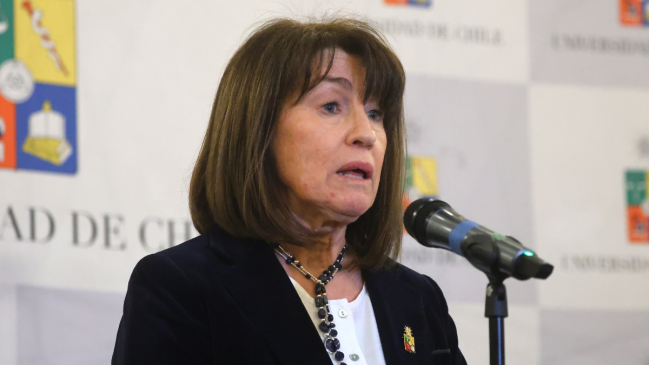
Chile's science budget is 'very low,' warns newly elected University of Chile rector
Translated from Spanish, summarized and contextualized by DistantNews.
At a glance
News
Sources not specified
New plan
- The newly elected rector of the University of Chile expresses concern over government science budget cuts.
- Chile's current science budget of 0.4% of GDP is significantly low compared to similarly developed nations.
- Investment in science is crucial for long-term national development, yielding important results over time.
Alejandra Mizala, the newly elected rector of the University of Chile, has voiced significant concern over government budget cuts impacting the science sector. She highlighted that Chile already allocates a "very low" budget to scientific development, standing at just 0.4% of its Gross Domestic Product (GDP).
We already have a very low budget in sciences: it is 0.4% of the GDP, which is very little if one compares it with countries of similar development.
Mizala emphasized that this figure is considerably low when compared to countries with similar levels of development. She stressed the critical need for increased investment in science, acknowledging that while applied science might show immediate results, non-applied science yields crucial benefits in the medium to long term. "We cannot tire of universities insisting on this again and again," Mizala stated, underscoring the persistent need to advocate for scientific funding.
She provided examples of the university's impactful research, including the Advanced Mining Technology Center (AMTC) within the Faculty of Physical and Mathematical Sciences, which works on optimizing copper processes vital to Chile's economy. Mizala also recalled the university's role during the "RSV virus" outbreak, where vaccines and immunization efforts, supported by research, prevented infant deaths and hospital collapses. Furthermore, the Faculty of Veterinary Sciences handles export food certifications, and the Faculty of Social Sciences provides assistance in the commune of Tiltil through the Public University Hospital, demonstrating the broad societal benefits derived from research.
We need to invest in science, regardless of whether, sometimes, in the short term, the results of that science that is not applied are not seen much, but in the medium to long term, it yields very important fruits. I think we cannot tire of universities insisting on this again and again.
Mizala's remarks underscore a broader debate about the value and funding of scientific research in Chile. The university, she argued, contributes significantly to the nation through its research endeavors, making a compelling case for sustained and increased government support for the scientific community.
So, a lot is done (for the benefit of the country) and all of that comes from research.
DistantNews Editorial
Originally published by Cooperativa in Spanish. Translated, summarized, and contextualized by our editorial team with added local perspective. Read our editorial standards.
More Stories


From Our Blog

What Gets Lost (and Found) When News Is Translated

The Critical Role of Diaspora Media in Global News

What Travellers Should Know About Countries with Restricted Press

A Digital Nomad's Guide to Following Local News

How the Same Story Looks Different in Different Countries
