

China approves first commercial brain implant, outpacing Elon Musk's Neuralink
Translated from Romanian, summarized and contextualized by DistantNews.
At a glance
News
Sources not specified
New plan
- China has approved its first brain-computer interface (BCI) device, NEO, for commercial use, potentially surpassing Elon Musk's Neuralink.
- The NEO implant is designed to aid patients with spinal cord injuries and paralysis by enhancing nervous system function.
- While offering medical promise, the technology raises ethical and security concerns regarding data vulnerability and potential cognitive manipulation.
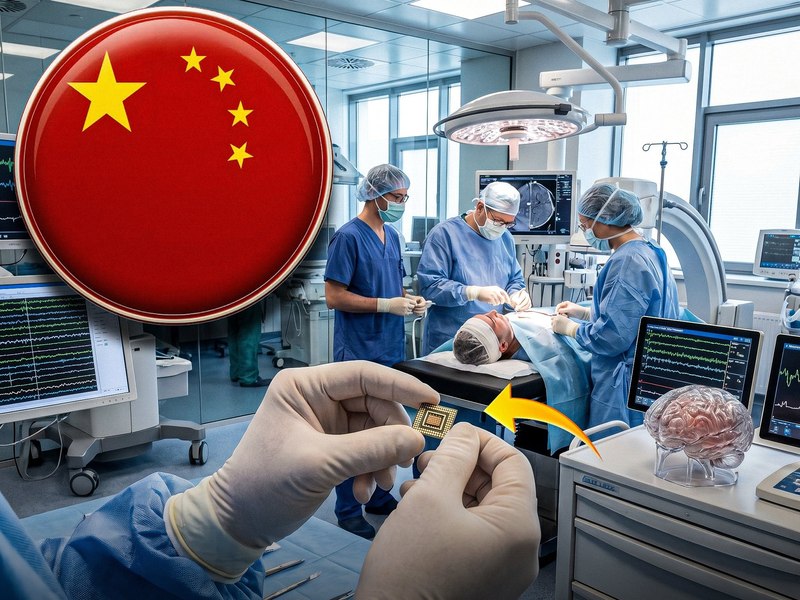
China has taken a significant step in the rapidly evolving field of brain-computer interfaces (BCIs) by approving its first device for commercial use. The coin-sized implant, named NEO, has successfully completed clinical trials, positioning China ahead of competitors like Elon Musk's Neuralink in bringing such technology to market.
Developed by researchers at Tsinghua University and Neuracle Technology, the NEO implant is initially intended to assist patients suffering from spinal cord injuries and paralysis. Its design aims to improve nervous system function, with plans for mass production for China's state healthcare system. The developers claim NEO's design is less invasive than existing solutions.
In contrast, Elon Musk's Neuralink is still undergoing clinical trials and has not yet received full regulatory approval in the United States for general use. The global neurotechnology race is heating up, with significant investment and research pouring into BCIs, which are seen as potentially transformative for medical applications.
Supporters envision BCIs integrating humans more deeply with artificial intelligence, potentially becoming indispensable in professional life. However, cybersecurity experts warn of substantial risks, including the vulnerability of neural data to hacking and manipulation of cognitive or motor functions. The commercial value of personal data generated by connected technologies also raises concerns, with major tech companies frequently mentioned in these discussions.
Despite the promise, brain implants remain experimental. Challenges include biological compatibility, the risk of rejection, and potential brain tissue damage. While NEO's preliminary results on dozens of patients are considered promising by its developers, the technology faces a long road of development and ethical consideration.
DistantNews Editorial
Originally published by Adevărul in Romanian. Translated, summarized, and contextualized by our editorial team with added local perspective. Read our editorial standards.
More Stories



From Our Blog

What Gets Lost (and Found) When News Is Translated

The Critical Role of Diaspora Media in Global News

What Travellers Should Know About Countries with Restricted Press

A Digital Nomad's Guide to Following Local News

How the Same Story Looks Different in Different Countries
