


China Points Out Life-Threatening Weakness in NASA's Artemis Moon Program
Translated from Vietnamese, summarized and contextualized by DistantNews.
At a glance
Analysis
Sources not specified
Context piece
- China's lunar program employs a design with four main engines, offering redundancy unlike NASA's Artemis program.
- NASA's Artemis relies on a single, high-power main engine, posing a significant risk if it malfunctions.
- China's approach, though complex, prioritizes astronaut safety through multiple, adjustable thrust engines and innovative fuel tank design.
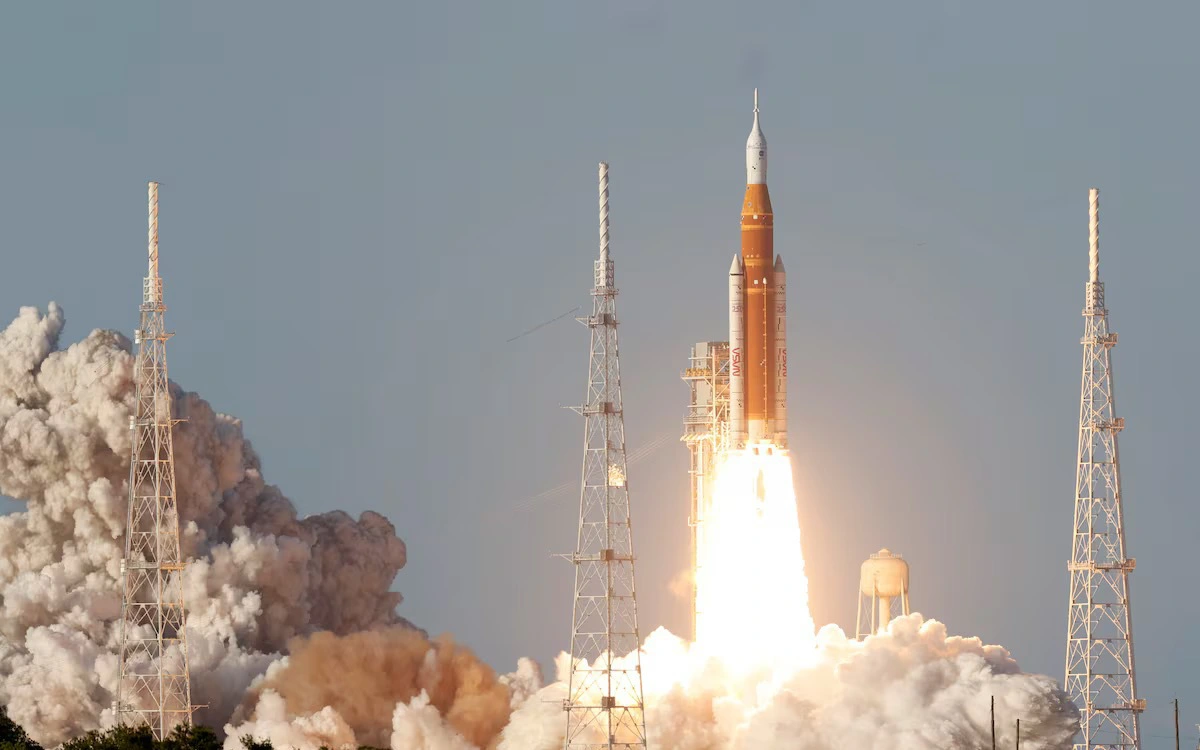
China's lunar exploration program is adopting a fundamentally different approach to astronaut safety compared to NASA's Artemis missions, with Chinese engineers highlighting critical weaknesses in the U.S. design. While NASA's Artemis II, scheduled for April 2026, relies on a single, powerful main engine for both lunar descent and return to Earth, China's lunar lander utilizes four main engines capable of adjustable thrust. This multi-engine configuration provides a crucial layer of redundancy; even if one engine fails, the remaining three can maintain sufficient thrust.
This design philosophy stems from a study published in China's Space Science and Technology journal in March, which identified NASA's single-engine reliance as a "fatal flaw." The Chinese system, generating over 30 kilonewtons of total thrust, ensures mission continuity even with partial engine failure. While a multi-engine setup is optimal, it presents challenges in mass management, a constant concern in spacecraft design. To overcome this, China has pioneered a shared-bulkhead fuel tank system for its crewed spacecraft. This innovative design, the first of its kind for a crewed mission using pressure-fed propulsion, eliminates redundant structural components, saving hundreds of kilograms and freeing up space for additional engines.
Implementing China's design requires mastery of automated pressure control under stringent safety conditions and complex synchronization of thrust across multiple engines. Meanwhile, NASA's ambitious Artemis program faces its own hurdles. The Starship system, developed by SpaceX for lunar landings, is a massive 50-meter-tall structure whose landing on the moon presents significant physical challenges and risks. Furthermore, Artemis test flights have encountered issues such as nitrogen leaks and thermal protection system damage, incidents that could have severe consequences for astronauts. Despite these challenges, the pressure on the U.S. to return to the moon, particularly in competition with China, continues to mount.
DistantNews Editorial
Originally published by Tuổi Trẻ in Vietnamese. Translated, summarized, and contextualized by our editorial team with added local perspective. Read our editorial standards.
More Stories



From Our Blog

What Gets Lost (and Found) When News Is Translated

The Critical Role of Diaspora Media in Global News

What Travellers Should Know About Countries with Restricted Press

A Digital Nomad's Guide to Following Local News

How the Same Story Looks Different in Different Countries
