

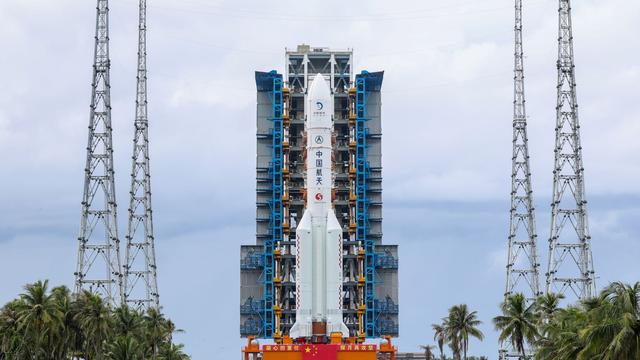

China postpones Chang'e 7 moon mission launch
Translated from German, summarized and contextualized by DistantNews.
At a glance
News
From a news agency
Ongoing story
- China has unexpectedly postponed the launch of its lunar probe, Chang'e 7.
- The state news agency cited principles of caution and reliability for the delay, with no exact reason given.
- A Thai research institute pointed to Tropical Storm Narra as the cause, while the mission aims to explore the moon's south pole for ice.
China has unexpectedly postponed the launch of its Chang'e 7 lunar probe, a mission critical to its ambitious space program. The state-run Xinhua news agency reported that the launch could not proceed within the planned timeframe, citing adherence to the principles of "caution, reliability, and absolute mission success."
While the Chinese space authority did not provide a specific reason for the delay, Thailand's National Astronomical Research Institute (Narit) suggested that Tropical Storm Narra, which had been hovering off the coast of Hainan, was the cause. The Chang'e 7 probe and its Long March 5 carrier rocket had already been transported to the launch site at the Wenchang Spacecraft Launch Site on the southern Chinese island of Hainan.
The unmanned mission is designed to investigate the lunar south pole, a region believed to contain permanently shadowed craters where ice may be preserved due to extremely low temperatures. The probe includes an orbiter, a lander, and a rover tasked with studying the environment and potential resources in this polar region. The findings are considered crucial for future long-term human stays on the Moon and the development of a planned lunar research station.
This postponement comes as China and the United States intensify their efforts to explore the Moon. NASA's Artemis program also targets the lunar south pole, with robotic and probe missions paving the way for astronauts to return to the Moon and establish a sustained presence. The Artemis-2 crew recently completed a historic test flight beyond the Moon, marking the longest distance ever traveled by humans in space. The crew will receive the highest U.S. space award for this achievement.
The assessment was made under the principles of caution, reliability, and absolute mission success.
DistantNews Editorial
Originally published by Der Spiegel in German. Translated, summarized, and contextualized by our editorial team with added local perspective. Read our editorial standards.
More Stories



From Our Blog

What Gets Lost (and Found) When News Is Translated

How the Same Story Looks Different in Different Countries

The Critical Role of Diaspora Media in Global News

What Travellers Should Know About Countries with Restricted Press

A Digital Nomad's Guide to Following Local News
