


China’s ‘electric eel’ sensor allows robots to feel an object without touching it
Summarized and contextualized by DistantNews.
At a glance
News
Sources not specified
Context piece
- Chinese scientists have developed an "electric eel" sensor that allows robots to detect objects without physical contact.
- The sensor mimics the electric eel's natural radar system, using an electric field to sense distortions caused by nearby objects.
- This technology enables robots to distinguish an object's material and surface condition before touching it.
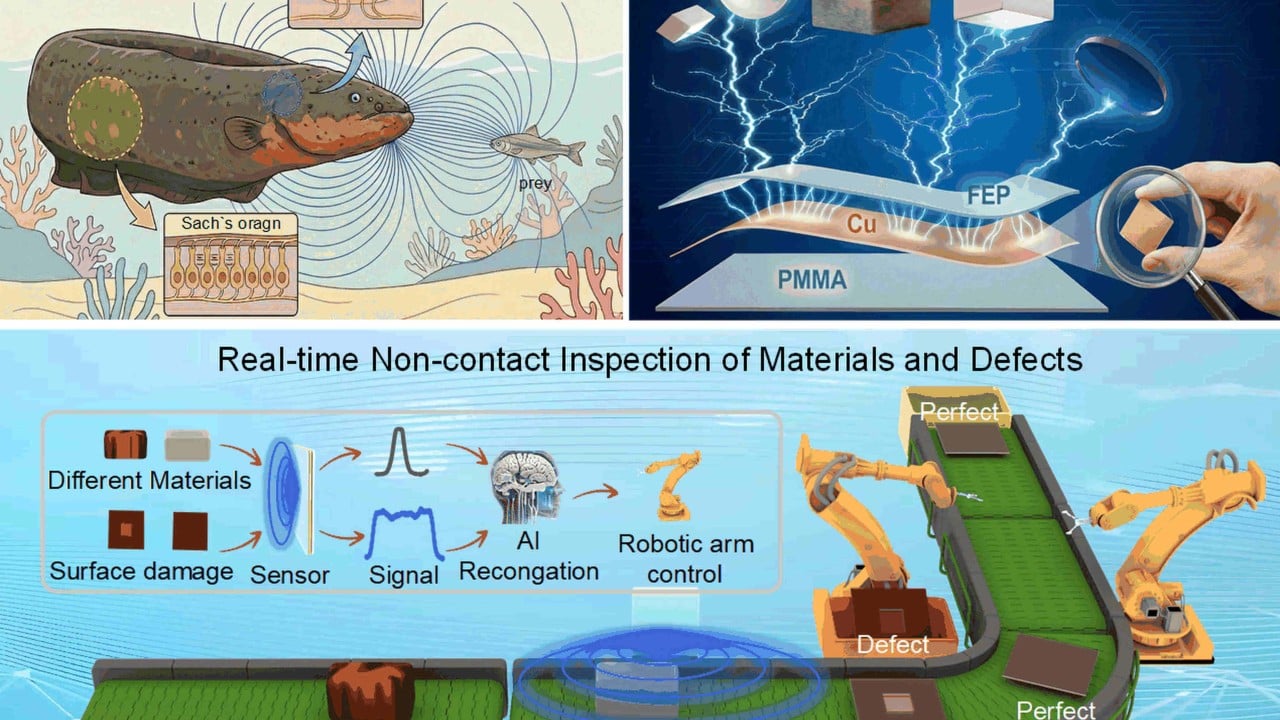
Inspired by the hunting mechanism of electric eels, Chinese scientists have created a novel sensor that grants robots the ability to perceive objects without direct physical contact. This breakthrough technology mimics the natural radar system of electric eels, which generate electric fields to locate prey in murky waters.
The sensor, developed by researchers at Xidian University, functions by creating a stable electric field around itself. This field acts as an invisible net, and when an object enters its proximity, the sensor detects distortions. These disturbances provide crucial information about the object's properties.
"We want the machine to sense an approaching target – distinguish its material and surface condition – before any physical contact," explained Zhang Weiqiang, a professor at Xidian University. The sensor is constructed from a specially treated fluoropolymer that functions like a miniature static battery, maintaining its charge and the surrounding electric field for extended periods.
By analyzing the changes in the electric field, the sensor can infer an object's electrical conductivity, dielectric properties, and geometric shape. This capability allows robots equipped with the sensor to gain a comprehensive understanding of their environment and the objects within it, even in conditions where visual or tactile sensing is impossible.
We want the machine to sense an approaching target – distinguish its material and surface condition – before any physical contact.
DistantNews Editorial
Originally published by South China Morning Post. Summarized and contextualized by our editorial team with added local perspective. Read our editorial standards.
More Stories



From Our Blog

Countries Without a Free Press: What You Need to Know

What Press Freedom Means for the News You Read

What Gets Lost (and Found) When News Is Translated

The Critical Role of Diaspora Media in Global News

What Travellers Should Know About Countries with Restricted Press
