


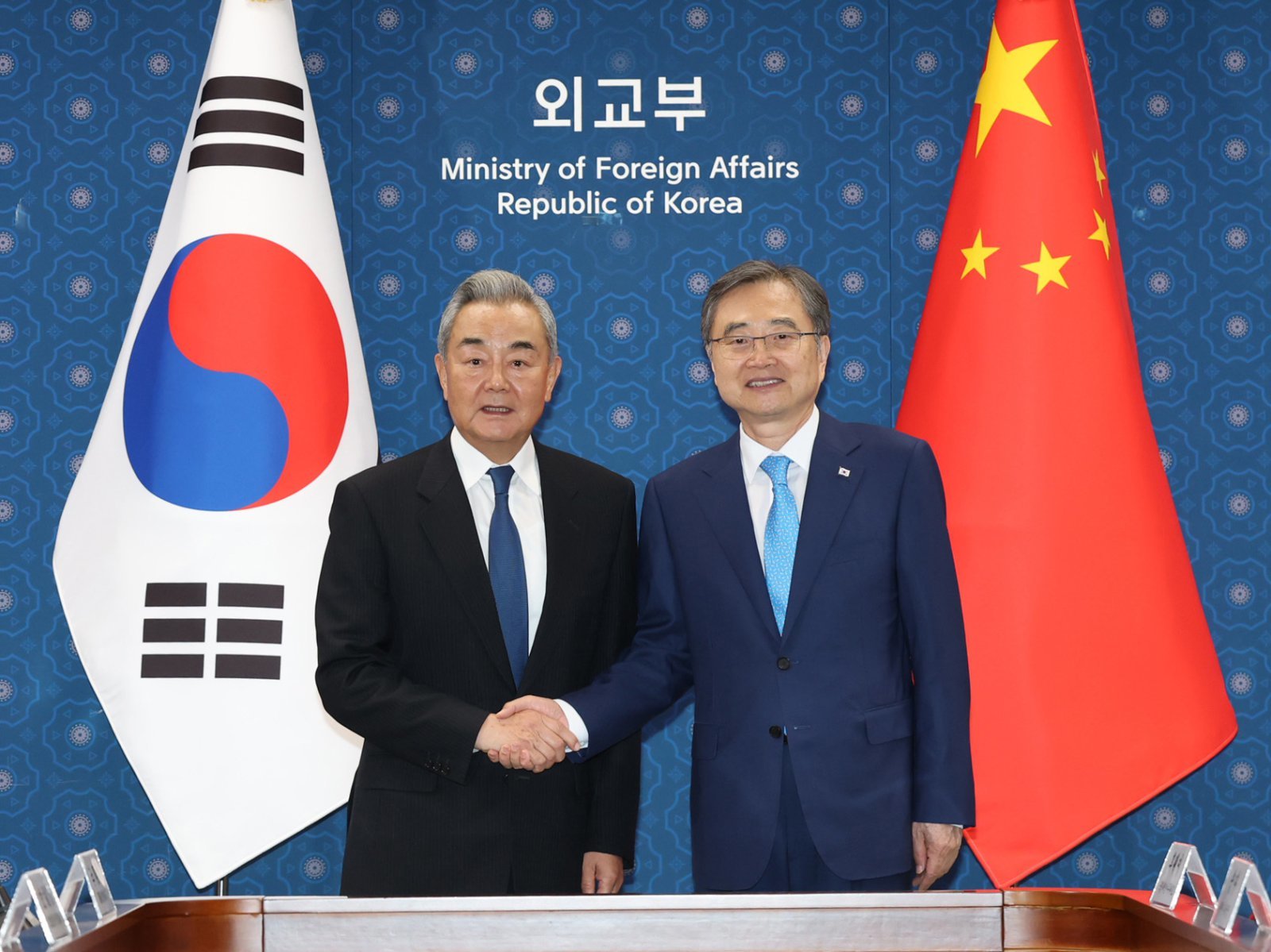
China will play constructive role for Korean Peninsula peace: Wang Yi
Translated from Korean, summarized and contextualized by DistantNews.
At a glance
News
Named sources
New plan
- Chinese Foreign Minister Wang Yi pledged to continue playing a constructive role in Korean Peninsula peace and stability during his visit to South Korea.
- Wang met with South Korean Foreign Minister Cho Hyun for bilateral talks.
- He emphasized the importance of strategic cooperation and healthy, sustainable development of China-South Korea relations.
Chinese Foreign Minister Wang Yi stated on August 19 that China will continue to play a constructive role in promoting peace and stability on the Korean Peninsula. Wang made the remarks during his official visit to South Korea, his first in five years, ahead of a meeting with South Korean Foreign Minister Cho Hyun. "We will continue to do what we ought to do," Wang said, emphasizing China's commitment to the peninsula's peace and development.
We will continue to play a constructive role for the peace and development, peace and stability of the Korean Peninsula.
The two foreign ministers held talks, the first in 11 months, at the Ministry of Foreign Affairs building. Wang described China and South Korea as "eternal friendly neighbors and continuous partners." He stressed the need to focus on the "fundamental interests of the two peoples" and ensure the "healthy and sustainable development" of bilateral relations. Wang expressed a desire to work with South Korea to elevate their strategic cooperative partnership to a "new stage."
We will continue to do what we ought to do.
Regarding the situation on the peninsula, Wang reiterated China's commitment to peace and stability. He indicated that both South Korea and North Korea are moving toward dialogue and reconciliation. Wang's visit and statements underscore China's ongoing diplomatic engagement with the region, aiming to foster stability and cooperation amidst complex geopolitical dynamics.
China and South Korea are eternal friendly neighbors and continuous partners.
DistantNews Editorial
Originally published by Dong-A Ilbo in Korean. Translated, summarized, and contextualized by our editorial team with added local perspective. Read our editorial standards.
More Stories


From Our Blog

What Gets Lost (and Found) When News Is Translated

The Critical Role of Diaspora Media in Global News

What Travellers Should Know About Countries with Restricted Press

A Digital Nomad's Guide to Following Local News

How the Same Story Looks Different in Different Countries
