

Chinese Robot 'Superman' Reportedly Outpaces Usain Bolt, Jumps Higher Than Record
Translated from Polish, summarized and contextualized by DistantNews.
At a glance
News
Named sources
Context piece
- A Chinese company, Unitree Robotics, has developed a humanoid robot prototype named 'Superman' that reportedly surpasses human speed and jumping records.
- The robot allegedly achieves a top speed of 12.66 m/s, faster than Usain Bolt's peak speed, and can jump 2 meters high from a standstill.
- Experts urge caution, noting the lack of independent verification and potential limitations in real-world application, despite the impressive engineering advancements.
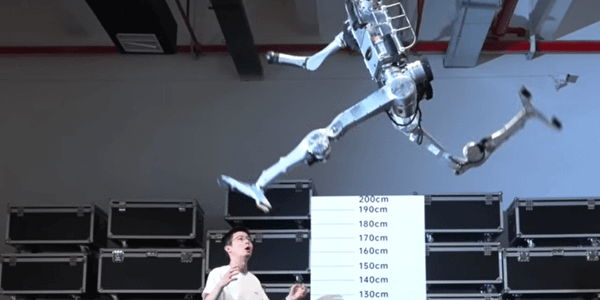
Unitree Robotics, a leading Chinese firm in bipedal robot design, has unveiled a prototype named 'Superman,' developed in just over three months. This 0.85-meter-tall robot is engineered to test the biomechanical and dynamic limits of robotic machines.
According to Unitree's claims, 'Superman' surpasses human athletic achievements. The company states the robot can reach a maximum speed of 12.66 meters per second (over 45.5 km/h), exceeding Usain Bolt's peak speed of approximately 12.42 m/s during his 100m world record. It also reportedly performs a standing vertical jump of 2 meters, surpassing the men's standing high jump record of 1.70 meters.
This development highlights the rapid progress in humanoid robotics. Unitree's previous fastest machine achieved 4.78 m/s at a competition last August, while its H1 model reached 10.1 m/s in April. The new prototype shows a more than 2.5-fold increase in speed within a year.
Superman remains an early research prototype. In the coming months, engineers must refine motion control, stability in terrain, and energy efficiency of the power supply.
However, experts advise a degree of skepticism. Unitree acknowledges 'Superman' is an early research prototype, with engineers needing to refine motion control, stability, and energy efficiency. The limited video evidence of the tests does not specify the conditions, number of attempts, or whether external support was used. Independent verification of these impressive figures is still pending.
Technological analysts suggest such extreme tests serve as "stress tests," pushing devices to their limits before adapting them for practical applications. The company's announcement coincided with a significant business milestone, raising questions about whether these laboratory records will translate into stable, commercially viable robots.
Extreme tests serve as 'stress tests,' practically allowing us to check the limits of devices and their durability before robots are 'adapted to real-world applications.'
DistantNews Editorial
Originally published by Rzeczpospolita in Polish. Translated, summarized, and contextualized by our editorial team with added local perspective. Read our editorial standards.
More Stories



From Our Blog

What Gets Lost (and Found) When News Is Translated

The Critical Role of Diaspora Media in Global News

What Travellers Should Know About Countries with Restricted Press

A Digital Nomad's Guide to Following Local News

How the Same Story Looks Different in Different Countries
