


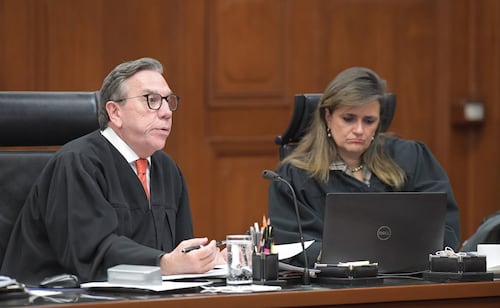
 Image: SCJN
“Chronicle of a failed reform”: Retired justice Javier Laynez says Mexico’s new Supreme Court is yielding to political power
Translated from Spanish and summarized by DistantNews. Read the original for the full story.
At a glance
Interview
Named sources
Context piece
- Javier Laynez Potisek said Mexico’s new Supreme Court has become an operator for the executive and legislative branches after judges began taking office through elections.
- He criticized the full court’s attendance at President Claudia Sheinbaum’s government report, calling it evidence of imprudence and weakened institutional independence.
- Laynez also warned that disciplinary bodies could punish judges for legal interpretations rather than misconduct, discouraging judicial independence.
Javier Laynez Potisek describes Mexico’s new Supreme Court as “the chronicle of a failed reform” one year after the first court elected at the ballot box began operating.
In an interview with Ciro Gómez Leyva on Grupo Fórmula, the retired justice said the court had functioned as “an operator for the authorities.” He criticized the attendance of the entire plenary at President Claudia Sheinbaum’s presentation of her second government report at the National Palace.
the chronicle of a failed reform
“The attendance of the entire plenary at an event of the president shows tremendous imprudence that they did not measure, or it really means that the loss of legitimacy they carry from the outset no longer matters,” Laynez said. In his view, the court no longer appears to need to preserve even the appearance of independence from political power.
Laynez argued that the court will become irrelevant because the governing bloc’s electoral overrepresentation leaves parliament with few, or no, opposition groups able to reach the one-third threshold required to challenge laws through constitutional actions. He also said constitutional disputes would become less frequent because constitutional bodies had disappeared, removing two important checks on power.
an operator for the authorities
He expressed particular concern about the Judicial Discipline Tribunal, which evaluates the performance of district judges and circuit magistrates. Laynez said disciplinary bodies should punish clear misconduct, such as workplace harassment, sexual harassment or accepting money in a case. They should not punish judges for matters of legal judgment.
“This creates uncertainty because addressing questions of judgment not only harms autonomy, it also inhibits the exercise of judicial functions, which produces submission or the co-option of judges,” he said.
This creates uncertainty because addressing questions of judgment not only harms autonomy, it also inhibits the exercise of judicial functions, which produces submission or the co-option of judges.
About this summary
Originally published by El Universal in Spanish. Translated, summarized, and contextualized automatically by DistantNews, with a note on how the source frames the story. Not individually reviewed before publishing. How this works.
More Stories


From Our Blog

What Press Freedom Means for the News You Read

What Gets Lost (and Found) When News Is Translated

The Critical Role of Diaspora Media in Global News

What Travellers Should Know About Countries with Restricted Press

A Digital Nomad's Guide to Following Local News
