

Chrysalis: The City-Ship Designed to House 1,000 People – The Vision of an Interstellar Civilization
Translated from Greek, summarized and contextualized by DistantNews.
At a glance
News
Sources not specified
Context piece
- The 'Chrysalis' is a conceptual interstellar spacecraft designed to transport 1,000 to 2,400 people away from Earth permanently.
- Spanning 58 kilometers, it's envisioned as a rotating city to generate artificial gravity, requiring advanced technologies for assembly and propulsion.
- The project, part of the Initiative for Interstellar Studies' Project Hyperion, faces significant technological hurdles in areas like fusion power, radiation shielding, and long-term system maintenance.
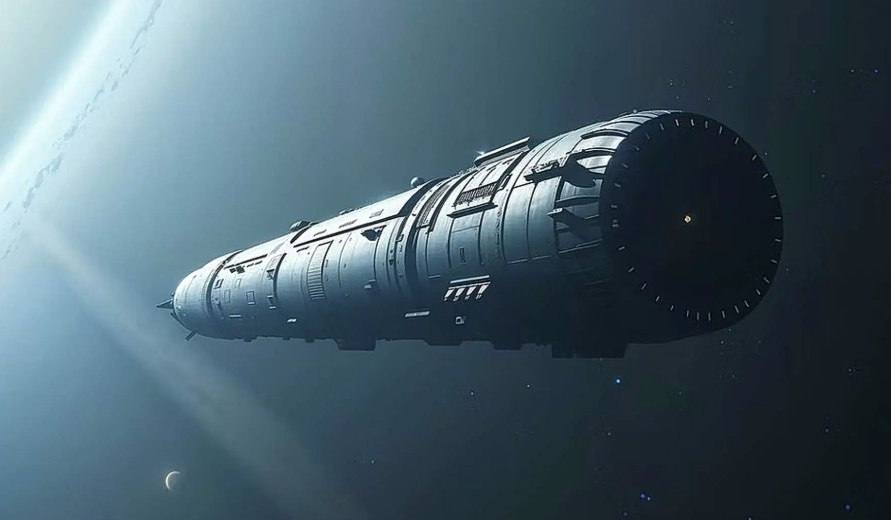
A groundbreaking concept called 'Chrysalis' envisions a city-sized spacecraft capable of carrying 1,000 to 2,400 people on a permanent journey to another star.
Designed as a solution to Earth's escalating crises, including climate change and geopolitical instability, Chrysalis is not intended for a return trip. The vessel, stretching an immense 58 kilometers, is conceived as a self-sustaining rotating city. Its rotation would generate artificial gravity, crucial for the long-term health and orientation of its inhabitants.
The design, a response to the Initiative for Interstellar Studies' Project Hyperion, proposes concentric cylinders rotating in opposite directions. The outer layers would simulate 90% of Earth's gravity, while internal structures would manage mechanical stresses. This massive scale necessitates assembly in space, likely at a Lagrange point, due to the limitations of current launch and construction technologies.
Propulsion would rely on a helium-3 and deuterium fusion reactor, enabling a year of acceleration, 400 years of travel, and a year of deceleration. However, the project faces immense technological challenges. A functional space-based fusion reactor does not yet exist, and issues such as thermal management, radiation shielding, material degradation over centuries, and onboard maintenance of hazardous systems remain significant obstacles. The ecological system also requires a closed-loop design, similar to but far more complex than that on the International Space Station.
DistantNews Editorial
Originally published by Ta Nea in Greek. Translated, summarized, and contextualized by our editorial team with added local perspective. Read our editorial standards.
More Stories



From Our Blog

What Gets Lost (and Found) When News Is Translated

The Critical Role of Diaspora Media in Global News

What Travellers Should Know About Countries with Restricted Press

A Digital Nomad's Guide to Following Local News

How the Same Story Looks Different in Different Countries
