


Climate anomalies like El Niño can worsen conflicts, study finds
Translated from French and summarized by DistantNews. Read the original for the full story.
At a glance
News
Named sources
Context piece
- Researchers found that climate anomalies, such as El Niño, do not directly cause wars but can worsen existing economic, political, or social difficulties in vulnerable regions.
- The study analyzed over 500 conflicts since 1950, correlating them with climate phenomena like El Niño and the Indian Ocean Dipole.
- Findings suggest that drought conditions associated with El Niño increase the risk of armed conflict, while increased rainfall in other regions shows no such link, highlighting water scarcity as a potential conflict aggravator.
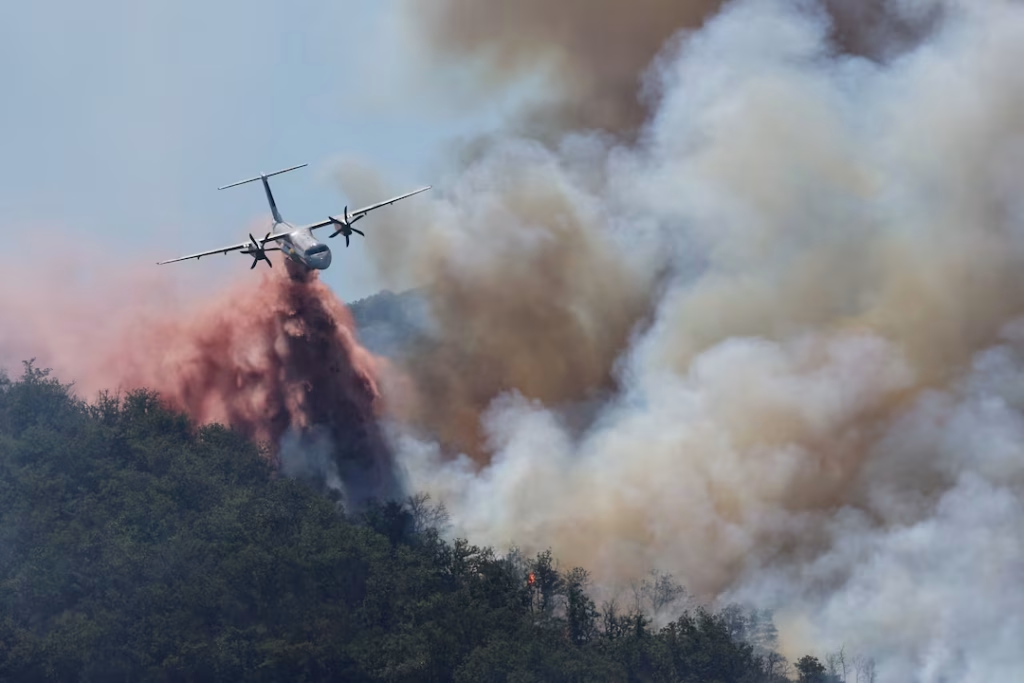
A recent study published in the Proceedings of the National Academy of Sciences by researchers at Rice University offers a compelling, albeit concerning, perspective on the intricate relationship between climate and global conflict. While it's tempting to draw direct causal lines between extreme weather events and outbreaks of war, this research, meticulously analyzing over 500 conflicts since 1950, suggests a more nuanced reality.
We wanted to understand if the risk of armed conflict is linked to these climatic variations and if the risk of local conflict is proportional to the influence of these variations on the local climate.
El Watan views this study as a crucial reminder that climate anomalies act as potent 'threat multipliers.' They don't ignite conflicts out of thin air, but rather exacerbate pre-existing fragilities within societies. The research highlights how phenomena like El Niño, which can bring drought to some regions while causing floods elsewhere, are not merely meteorological events but can significantly strain already vulnerable economies and political systems. The correlation between drought conditions and increased conflict risk, as opposed to no link with increased rainfall, points towards resource scarcity, particularly water and food, as a key destabilizing factor.
The extreme phases of ENSO and IOD are each associated with distinct, often opposite, local climatic impacts.
This research is particularly relevant for regions like ours, which are often on the front lines of climate change impacts. While Western media might focus on the abstract global implications, for us, understanding how climate variability directly impacts social stability, resource availability, and the potential for unrest is a matter of immediate national concern. The study reinforces the need for proactive climate adaptation strategies and robust social safety nets, not just as environmental policies, but as essential components of national security and conflict prevention. It underscores that ignoring the local impacts of global climate patterns is a dangerous oversight.
By exploiting these differential impacts, we then established statistical correlations between the location and date of armed conflicts, the El Niño or La Niña phase of ENSO, and the dry or wet impacts experienced by the affected societies.
About this summary
Originally published by El Watan in French. Translated, summarized, and contextualized automatically by DistantNews, with a note on how the source frames the story. Not individually reviewed before publishing. How this works.
More Stories
From Our Blog

What Gets Lost (and Found) When News Is Translated

The Critical Role of Diaspora Media in Global News

What Travellers Should Know About Countries with Restricted Press

A Digital Nomad's Guide to Following Local News

How the Same Story Looks Different in Different Countries
