


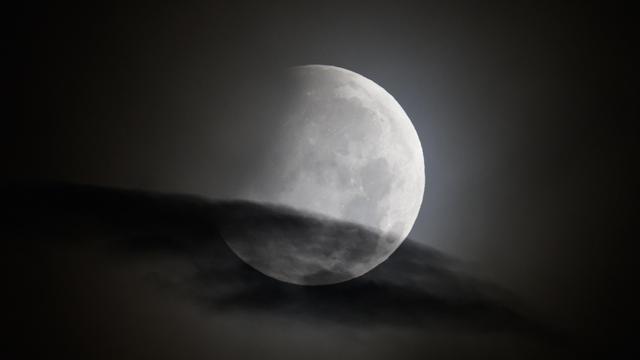
Clouds Obscure Partial Lunar Eclipse Over Germany
Translated from German and summarized by DistantNews. Read the original for the full story.
At a glance
News
From a news agency
Outcome reported
- A partial lunar eclipse occurred early on August 28, 2026, with the moon entering Earth's umbra at 4:34 AM.
- Widespread cloud cover and thunderstorms across Germany significantly limited visibility.
- While the event was largely unobservable in Germany, it was visible in other parts of the world, including the US, Bolivia, and Italy.
Stargazers in Germany hoping to witness a partial lunar eclipse were largely thwarted by persistent cloud cover and adverse weather conditions. The event, which began at 4:34 AM local time, saw the moon partially enter Earth's umbra, the darkest part of its shadow.
the partial darkening of the moon began at 4:34 our time. However, the event could not be observed in large parts of Germany due to heavy cloud cover.
Meteorologists from the German Weather Service (DWD) reported that the dense cloud formations likely made the eclipse invisible across most of the country. In some regions, heavy thunderstorms further compounded the poor viewing conditions. DWD expert Martin Jonas indicated that the chances of seeing the eclipse were slim, with only a few exceptions potentially in southern and central Germany.
A dpa reporter noted that the moon was visible in eastern Brandenburg before the partial eclipse began. The initial phase of the eclipse, occurring shortly after 4:30 AM, would have been the best time to observe it, provided there were clear skies or a break in the clouds. The moon was still high in the sky during this period, bathed in the darkness of night.
probably one could not see the partial lunar eclipse anywhere because of the relatively dense cloud cover over Germany.
The timing of the eclipse also coincided with the onset of dawn, further diminishing the contrast against the brightening sky. The partial eclipse concluded at 7:52 AM, by which time the moon had already set in many areas. While Germany missed out, the celestial spectacle was captured in photographs from the United States, Bolivia, and Italy, showcasing the phenomenon to a global audience.
the moon was visible in eastern Brandenburg before the partial eclipse began.
For those who missed this event, the next partial lunar eclipse, also known as a penumbral eclipse, is scheduled for the night of February 21, 2027. A total lunar eclipse will not occur again until December 31, 2028.
the increasing darkening of the moon coincided with dawn.
About this summary
Originally published by Die Zeit in German. Translated, summarized, and contextualized automatically by DistantNews, with a note on how the source frames the story. Not individually reviewed before publishing. How this works.
More Stories



From Our Blog

What Gets Lost (and Found) When News Is Translated

How the Same Story Looks Different in Different Countries

The Critical Role of Diaspora Media in Global News

What Travellers Should Know About Countries with Restricted Press

A Digital Nomad's Guide to Following Local News
