


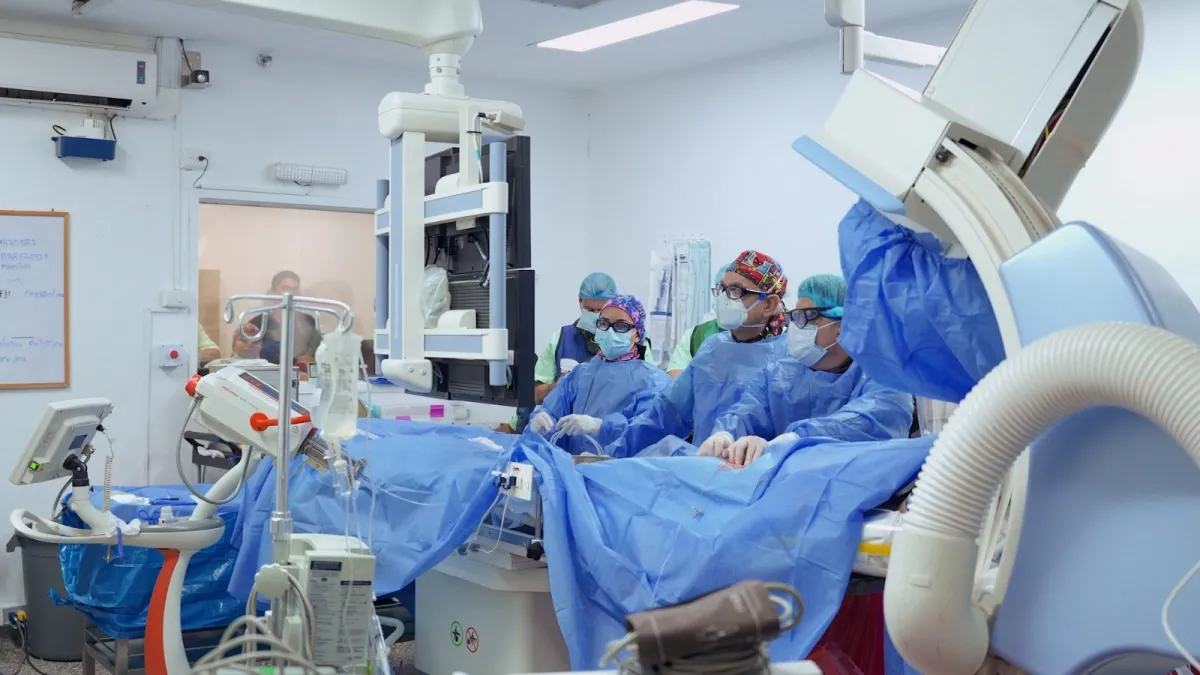
Colombia performs first Harmony pulmonary valve implant, avoiding open-heart surgery
Translated from Spanish, summarized and contextualized by DistantNews.
At a glance
News
Sources not specified
New plan
- Colombia has performed its first implantation of the Harmony pulmonary valve, a technology that avoids open-heart surgery.
- The minimally invasive procedure offers faster recovery for patients with congenital heart defects.
- This advancement positions Colombia at the forefront of interventional cardiology.
In Bucaramanga, the Hospital Internacional de Colombia (HIC) and its Cardiovascular Institute have achieved a medical milestone by performing the first implantation of the Harmony pulmonary valve in Colombia. This innovative technology allows for the treatment of congenital heart defects without the need for open-heart surgery, promising a quicker recovery for patients.
The procedure benefited a teenager who had previously undergone surgery for Tetralogy of Fallot, a condition often requiring early surgical correction. Over time, the pulmonary valve can deteriorate, leading to insufficiency and straining the right ventricle. Previously, the only recourse was another major surgery.
The novelty of this technology is that it allows us to treat these patients without opening the chest. Through a small incision in the leg, we access the femoral vein and, using a catheter, we take the valve to the heart. This favors a faster recovery.
Led by pediatric cardiologist and interventionalist Dr. Justo Santiago, along with a multidisciplinary team and international experts, the procedure utilized a catheter inserted through a small incision in the leg. This approach delivered the valve to the heart, significantly reducing recovery time. "The novelty of this technology is that it allows us to treat these patients without opening the chest," explained Dr. Santiago.
Its self-expanding design allows for a firm and stable anchor even in difficult anatomies.
The Harmony valve, made from a flexible, self-expanding nitinol material and incorporating porcine biological tissue, eliminates the need for permanent anticoagulation. Its self-expanding design ensures a firm and stable anchor even in complex anatomies. The catheterization procedure, guided by pre-operative imaging like echocardiograms, CT scans, and MRIs, allowed the valve to be placed without stopping the heart's function, enabling the patient to be discharged in less than 48 hours.
This advancement makes the Cardiovascular Institute the first institution in the country to adopt this technology, solidifying Colombia's position in interventional cardiology and offering a life-improving alternative for young patients with a history of cardiac surgery.
As it is a minimally invasive procedure, most of our patients can return home on their own in the first 48 hours.
DistantNews Editorial
Originally published by El Tiempo in Spanish. Translated, summarized, and contextualized by our editorial team with added local perspective. Read our editorial standards.
More Stories


From Our Blog

What Gets Lost (and Found) When News Is Translated

The Critical Role of Diaspora Media in Global News

What Travellers Should Know About Countries with Restricted Press

A Digital Nomad's Guide to Following Local News

How the Same Story Looks Different in Different Countries
