


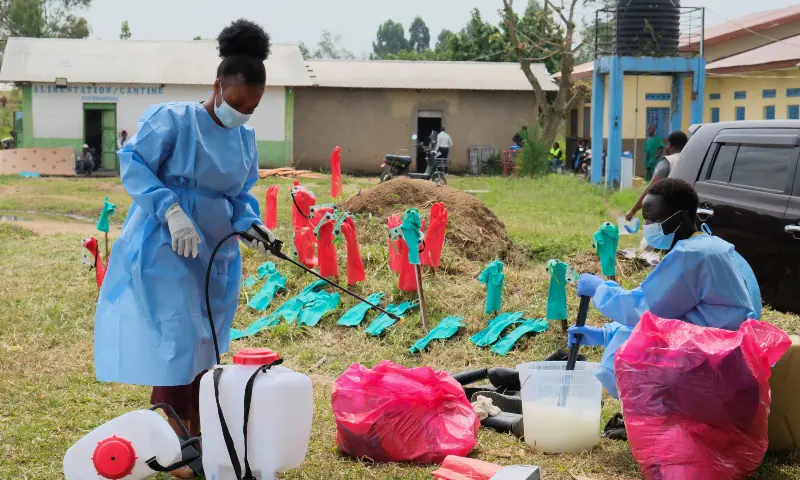
Congo Ebola response strained a month after WHO declares international emergency
Summarized and contextualized by DistantNews.
At a glance
News
Named sources
Ongoing story
- Health workers in eastern Democratic Republic of Congo face severe shortages of personnel, ambulances, and materials to combat an Ebola outbreak.
- The outbreak, declared an international emergency by the WHO a month ago, has surpassed 800 confirmed cases.
- Insecurity and the outbreak's location in urban and mining areas present significant obstacles to containment efforts, leaving tens of thousands of contacts untraced.
Health workers battling an Ebola outbreak in the eastern Democratic Republic of Congo are critically short of essential resources, hindering their ability to respond effectively. Officials and aid workers report a lack of personnel to identify suspected cases, insufficient ambulances for transport, and a deficit of construction materials needed to build isolation wards.
Health workers battling an Ebola outbreak in eastern Democratic Republic of Congo lack the personnel to identify suspected cases, the ambulances to transport them and even the construction materials to build isolation wards.
This situation arises a month after the World Health Organization declared an international emergency for the outbreak of the rare Bundibugyo strain. The number of confirmed cases has now exceeded 800. Experts warn that the epidemic could become the worst on record, potentially surpassing the devastating West Africa epidemic of 2014-16, which claimed over 11,000 lives.
tens of thousands of contacts of those cases remain untraced
The strain on health teams is immense, with tens of thousands of contacts of confirmed cases remaining untraced, according to Jean Kaseya, director general of the Africa Centres for Disease Control and Prevention. Kaseya pointed to ongoing insecurity and the outbreak's presence in urban centers and mining regions as major obstacles to containment efforts. The challenges underscore the complex and difficult conditions under which responders are operating.
pointing to insecurity and the urban, mining-heavy setting of the outbreak as central obstacles.
DistantNews Editorial
Originally published by Dawn. Summarized and contextualized by our editorial team with added local perspective. Read our editorial standards.
More Stories



From Our Blog

What Gets Lost (and Found) When News Is Translated

The Critical Role of Diaspora Media in Global News

What Travellers Should Know About Countries with Restricted Press

A Digital Nomad's Guide to Following Local News

How the Same Story Looks Different in Different Countries
