


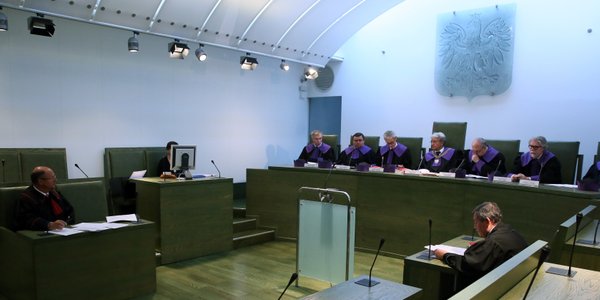
Constitutional Tribunal: Seven-Judge Supreme Court Resolutions Cannot Set Legal Precedent
Translated from Polish, summarized and contextualized by DistantNews.
At a glance
News
Sources not specified
Outcome reported
- Poland's Constitutional Tribunal ruled that resolutions by seven-judge panels of the Supreme Court cannot have the force of legal precedent.
- The tribunal, led by its president Bogdan Święczkowski, stated that assigning such significant tasks to a small group of judges may infringe on their interpretive autonomy and violate proportionality.
- The ruling stems from a case where a lower court's decision was appealed to the Supreme Court, but a prior Supreme Court resolution created a procedural hurdle.
Poland's Constitutional Tribunal has declared that resolutions adopted by seven-judge panels of the Supreme Court cannot hold the status of legal precedent. The tribunal, under the leadership of its president Bogdan Święczkowski, found that granting such significant authority to a narrow group of judges could undermine their interpretive autonomy and breach the constitutional principle of proportionality.
The ruling does not dispute the Supreme Court's general ability to issue resolutions. Instead, it specifically targets the practice of seven-judge panels imbuing their decisions with legal force. Henceforth, only broader Supreme Court compositions, such as the full court or its chambers, will possess this authority. This aspect was not challenged by the three Supreme Court justices who initiated the inquiry.
The case that prompted this constitutional question involved a 2019 ruling by a regional court, which awarded a portion of the demanded sum to plaintiffs from a defendant company. The plaintiffs subsequently filed a complaint with the Supreme Court, alleging the final judgment was unlawful. This type of complaint is typically used when other remedies, like a cassation appeal, are unavailable, as was the case here due to the low value of the disputed amount.
Assigning such serious activities to such a narrow group, which affect the jurisprudence of other judges, may violate their interpretive autonomy and exceed the constitutional principle of proportionality.
A prior resolution from October 15, 2020, by a seven-judge panel of the Supreme Court's Labor Chamber (case file III PZP 4/20) had created a significant obstacle. This resolution, which was given the force of legal precedent, dictated that no Supreme Court panel could reject such a complaint based on the claimant's failure to demonstrate that overturning the contested judgment through other means was impossible. This ruling altered the established legal practice within the Civil Chamber, preventing any Supreme Court panel from rejecting complaints or interpreting the matter differently.
The justices who questioned the practice argued that the issue was not the correctness of the seven-judge panel's interpretation but the very authority of such a panel to bind other Supreme Court compositions. They contended that this practice could allow for the shaping of legal norms with effects akin to legislation.
The issue is not the correctness of the resolution, but the fact that the resolution binds other panels.
DistantNews Editorial
Originally published by Rzeczpospolita in Polish. Translated, summarized, and contextualized by our editorial team with added local perspective. Read our editorial standards.
More Stories



From Our Blog

What Gets Lost (and Found) When News Is Translated

The Critical Role of Diaspora Media in Global News

What Travellers Should Know About Countries with Restricted Press

A Digital Nomad's Guide to Following Local News

How the Same Story Looks Different in Different Countries
