


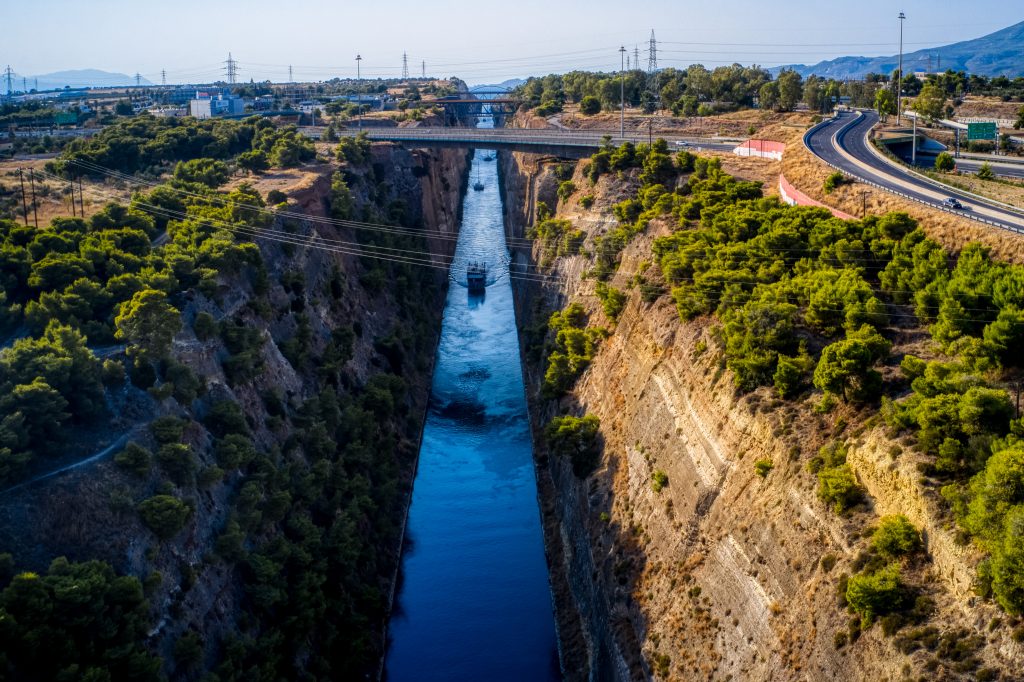
Corinth Canal Fully Operational After Restoration, Poised for New Development
Translated from Greek, summarized and contextualized by DistantNews.
At a glance
News
Sources not specified
Outcome reported
- The Corinth Canal has fully reopened after extensive restoration and slope stabilization work, resuming its role as a vital strategic passage.
- The canal serves over 11,000 commercial and private vessels annually, connecting the Aegean Sea to the Ionian and Adriatic Seas and significantly reducing travel time and costs.
- The managing company, AEDIK, is investing in digital transformation and aims to develop the Isthmus into an international hub for tourism, culture, history, and business.
The Corinth Canal, a landmark of Greek infrastructure for 132 years, has fully reopened, marking a significant return to operation after extensive restoration efforts. The canal, which connects the Aegean Sea to the Corinthian and Ionian Seas, is not only a spectacular sight for thousands of travelers but also a crucial strategic waterway for maritime navigation, saving considerable time, fuel, and costs.
Managed by the Corinth Canal S.A. (AEDIK), a company wholly owned by the Hellenic Republic Asset Development Fund (HRADF), the canal is a unique Greek public infrastructure. It functions simultaneously as a maritime passage, a tourist attraction, a historical monument, and an internationally recognized technical achievement. Despite changes in global shipping since its inauguration in 1893, the canal remains vital, facilitating the passage of over 11,000 commercial and private vessels annually from more than 70 different nationalities. It is particularly important for regional maritime transport and the growing yachting sector in the Mediterranean.
AEDIK is embracing digital transformation, with 78% of yacht passages now utilizing new electronic notification and payment services. The company is continuously developing digital services for both business-to-business clients and individual users, aiming for faster service, flexibility, and an improved overall customer experience. Beyond managing the waterway, AEDIK's responsibilities extend to port facilities at both entrances, submersible bridges, and significant landholdings in the surrounding area.
The strategic vision for the Isthmus is to transform it into an international destination that integrates tourism, culture, history, and business activities. Nasos Bikas, CEO of AEDIK, described the Corinth Canal as an "iconic landmark with a present, a past, and a promising future." He emphasized its strategic importance for navigation, its strong international recognition, and its considerable development potential for the wider region, highlighting the company's aim to enhance its multifaceted role.
A unique infrastructure that combines strategic importance for navigation, strong international recognition, and significant development potential for the wider region.
DistantNews Editorial
Originally published by Ta Nea in Greek. Translated, summarized, and contextualized by our editorial team with added local perspective. Read our editorial standards.
More Stories



From Our Blog

What Gets Lost (and Found) When News Is Translated

The Critical Role of Diaspora Media in Global News

What Travellers Should Know About Countries with Restricted Press

A Digital Nomad's Guide to Following Local News

How the Same Story Looks Different in Different Countries
