


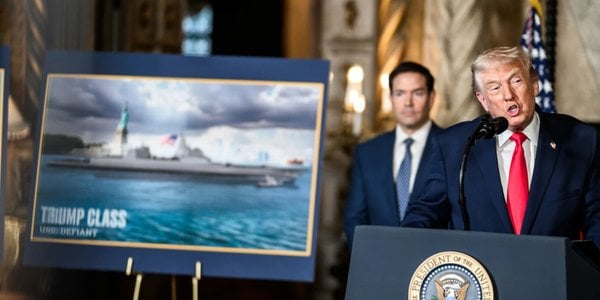
Costs of non-existent ships are rising. "Trump's battleships" could cost $800 billion
Translated from Polish, summarized and contextualized by DistantNews.
At a glance
News
Documents & data
New plan
- The first "Trump-class" battleship could cost $23.4 billion, with 14 subsequent ships averaging $18 billion each, totaling $275 billion.
- The U.S. Navy's initial estimate for the program was significantly lower, at $217.6 billion for 25 ships.
- Congress is hesitant to fund ships without fully developed weapon systems, citing past failures like the Zumwalt-class destroyers.
The United States faces potentially staggering costs for its proposed "Trump-class" battleships, with a recent Congressional Budget Office (CBO) analysis revealing a projected price tag of $23.4 billion for the first vessel. An additional 14 ships of the same class are estimated to cost an average of $18 billion each, bringing the total for the initial fleet to approximately $275 billion in 2026 dollars. These expenditures are planned to occur between 2027 and 2056.
If the U.S. administration were to pursue its previously stated goal of acquiring 25 such battleships, the overall cost could escalate to around $455 billion. This CBO report was commissioned by Senator Jeff Merkley, the vice-chairman of the Senate Budget Committee. For comparison, the latest U.S. nuclear-powered aircraft carrier, the USS Gerald R. Ford, cost $13.3 billion, while subsequent carriers of its class are expected to cost about $22 billion. Strategic Columbia-class submarines are priced at approximately $10 billion each.
The U.S. Navy's own shipbuilding plan for fiscal year 2027 had estimated the cost of the first ship at $17.47 billion and the entire program at $217.6 billion. The CBO's figures add over $57 billion to these initial estimates.
Beyond the financial implications, a significant political dispute surrounds the "Trump-class" battleships. The House Armed Services Committee has included a provision in the fiscal year 2027 National Defense Authorization Act (NDAA) that could effectively halt the program. This provision stipulates that the Secretary of the Navy cannot enter into a contract for the construction of a "lead ship" until they certify to the defense committees that the planned weapon systems have reached a sufficiently mature technological readiness level for combat use.
While specific systems are not named, it is widely understood that this refers to the electromagnetic railgun, high-power lasers, and hypersonic missiles intended for these new vessels. None of these advanced weapon systems have been fully tested or widely deployed. The U.S. has a history of costly failures with programs that involve building vessels for undeveloped weapon systems, exemplified by the original configuration of the advanced Zumwalt-class destroyers. Their main artillery became practically useless when the specially designed LRLAP projectiles proved too expensive, leading to their cancellation after the first ships were built.
DistantNews Editorial
Originally published by Rzeczpospolita in Polish. Translated, summarized, and contextualized by our editorial team with added local perspective. Read our editorial standards.
More Stories


From Our Blog

What Gets Lost (and Found) When News Is Translated

The Critical Role of Diaspora Media in Global News

What Travellers Should Know About Countries with Restricted Press

A Digital Nomad's Guide to Following Local News

How the Same Story Looks Different in Different Countries
