


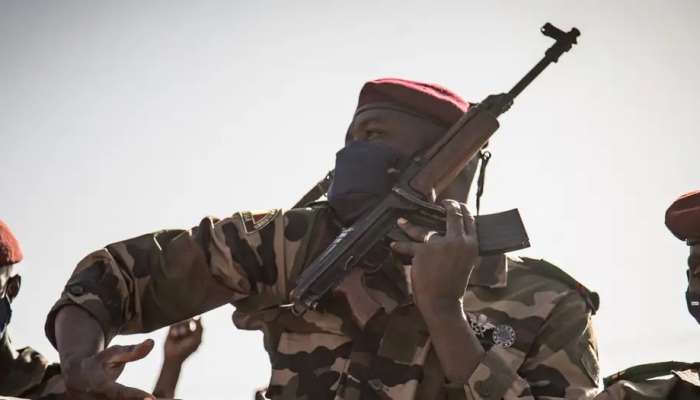
Could US airstrikes stop Mali's growing insurgency?
Translated from English, summarized and contextualized by DistantNews.
At a glance
News
Named sources
Context piece
- Mali struggles to contain a growing insurgency, particularly in its northern region, despite Russian cooperation and French troop withdrawal.
- The US National Counterterrorism Center reported JNIM was responsible for over 1,200 deaths in 2025, making it the world's second-deadliest terrorist organization.
- Mali's government has responded cautiously to potential US airstrikes, emphasizing its reliance on its own security forces and sovereignty.
Mali is grappling with a persistent insurgency, especially in its northern territories, a situation that has worsened despite the withdrawal of French forces and ongoing cooperation with Russia. The Jama'at Nusrat al-Islam wal-Muslimin (JNIM), an al-Qaeda-affiliated group, has significantly expanded its influence, effectively controlling security in many regions, collecting taxes, and mediating local conflicts, often proving more present than the Malian state itself.
We are no longer talking about a group that only carries out isolated attacks. In many regions, JNIM effectively controls the security situation, collects taxes, mediates local conflicts and in some areas is more present than the Malian state.
According to the US National Counterterrorism Center, JNIM caused over 1,200 deaths in 2025, positioning it as the world's second-deadliest terrorist organization. The group's expansion into Burkina Faso, Niger, and increasingly into West Africa's coastal states has raised alarms in the US. The US government is divided on direct military action, with proponents like Sebastian Gorka arguing that JNIM's advance must be halted due to its dangerous nature. Gorka also noted that Russia's security strategy in Mali has failed to yield results, contrary to expectations following the withdrawal of French and European missions.
That expectation has not been fulfilled so far. On the contrary, JNIM appears stronger today than it was several years ago.
Mali's military government, which distanced itself from Western partners after coups in 2020 and 2021, has reacted cautiously to reports of potential US airstrikes. Foreign Minister Abdoulaye Diop stated that Mali had received no confirmation from the US and asserted that the country is not passively awaiting external solutions. He emphasized Mali's reliance on its own security forces and the preservation of its sovereignty.
We have received absolutely no confirmation from the United States. But I can assure you that Mali is not simply sitting and waiting for others to come and solve our problem.
Public opinion in Mali is divided. While some residents welcome any measure that brings peace, others express concern about the presence of both Russian and potentially American forces on their soil, trusting the authorities to manage the situation.
Anything that ultimately brings us peace, throughout the entire territory of the country, is welcome.
DistantNews Editorial
Originally published by Times of Oman in English. Translated, summarized, and contextualized by our editorial team with added local perspective. Read our editorial standards.
More Stories
From Our Blog

What Gets Lost (and Found) When News Is Translated

The Critical Role of Diaspora Media in Global News

What Travellers Should Know About Countries with Restricted Press

A Digital Nomad's Guide to Following Local News

How the Same Story Looks Different in Different Countries
