


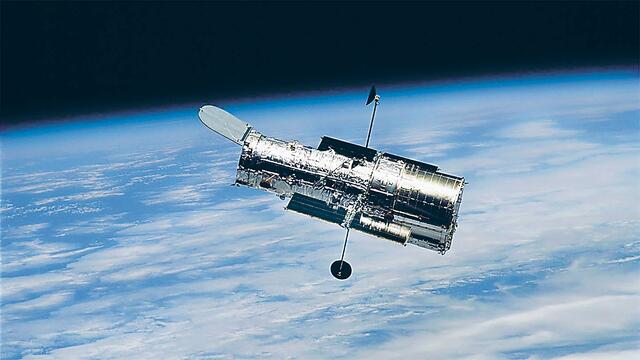
Countdown for the legendary Hubble Space Telescope - Where will it end up?
Translated from Greek, summarized and contextualized by DistantNews.
At a glance
In-depth
Sources not specified
Context piece
- After 36 years in orbit, the iconic Hubble Space Telescope is facing a decision about its future, with NASA considering two options: extending its mission or a controlled deorbit.
- The Hubble has provided over 150 terabytes of data, contributing to nearly 23,000 scientific articles and fundamentally reshaping modern astronomy.
- Scientists advocate for extending Hubble's mission, arguing it remains crucial for observing ultraviolet and visible light, complementing the James Webb Space Telescope's infrared capabilities.
The legendary Hubble Space Telescope, after 36 years of groundbreaking observation, is at a crossroads. Launched on April 24, 1990, aboard the Space Shuttle Discovery, Hubble was initially designed for a 15-year lifespan. However, through five complex servicing missions, including a critical 1993 repair to its main mirror, the telescope has far exceeded expectations, now entering its fourth decade of service.
The perception that James Webb has rendered Hubble obsolete is a major misunderstanding, as the two instruments complement each other like the instruments of an orchestra.
During its mission, Hubble has captured over 1.7 million observations, leading to 1.5 million academic reports and nearly 23,000 scientific articles. It has delivered more than 150 terabytes of invaluable data, utilized by approximately 29,000 astronomers from 40 countries. This vast archive has fundamentally rewritten modern astronomy textbooks, offering unprecedented views of the cosmos.
Now, a NASA task force is weighing two distinct paths for the veteran observatory. One option involves a robotic mission to dock with Hubble and boost it into a higher, more stable orbit, potentially extending its operational life into the 2030s. The alternative, a more somber choice, is a robotic mission to capture the telescope, dismantle it, and guide it through a controlled atmospheric re-entry, ultimately sinking its remains in the ocean.
While James Webb has excellent 'hearing' in infrared frequencies, piercing the dense cosmic dust to capture the 'deep bass' of the universe, Hubble is the only one that can distinguish optical and ultraviolet light, the 'violins' and 'flutes' emitted by the youngest, hottest, and most active stars.
Scientists are strongly urging against decommissioning Hubble, emphasizing its continued irreplaceable contribution. They argue that the perception of Hubble being obsolete due to the newer James Webb Space Telescope is a misunderstanding. While Webb excels in infrared frequencies, Hubble remains unique in its ability to observe visible and ultraviolet light. Losing Hubble would leave a significant gap in astronomical observation, as its intended successor, the Habitable Worlds Observatory, is not expected to launch until the 2040s. Hubble's legacy extends beyond scientific discovery; it has also democratized science by bringing the beauty of nebulae and galaxies to the public.
The loss of Hubble would leave science blind to these frequencies, as its true successor, the Habitable Worlds Observatory, is not expected to launch before the 2040s.
DistantNews Editorial
Originally published by Ta Nea in Greek. Translated, summarized, and contextualized by our editorial team with added local perspective. Read our editorial standards.
More Stories



From Our Blog

What Gets Lost (and Found) When News Is Translated

The Critical Role of Diaspora Media in Global News

What Travellers Should Know About Countries with Restricted Press

A Digital Nomad's Guide to Following Local News

How the Same Story Looks Different in Different Countries
