


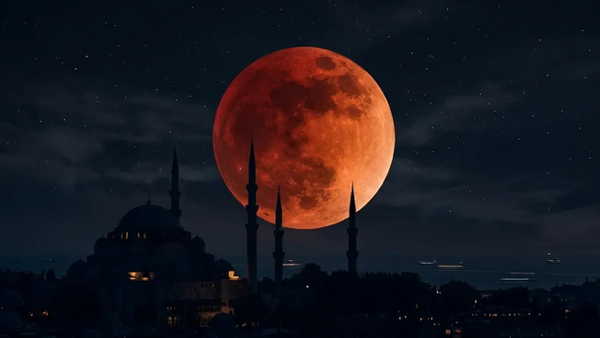
Countdown to 'Blood Moon': When and where to watch the partial lunar eclipse in Turkey
Translated from Turkish, summarized and contextualized by DistantNews.
At a glance
News
Sources not specified
Context piece
- A partial lunar eclipse, visible in Turkey, will reach its peak during sunrise on August 28.
- The eclipse will begin in Istanbul with a penumbral phase at 4:23 AM and a partial phase at 5:33 AM.
- Observers are advised to find locations with clear western-southwestern horizons, away from obstructions and light pollution, for the best viewing experience.
Skygazers in Turkey can anticipate a partial lunar eclipse on the morning of August 28, with the most dramatic phase occurring just before sunrise. In Istanbul, the penumbral phase, where the Moon passes through Earth's fainter outer shadow, will begin at 4:23 AM. The more noticeable partial eclipse, when a portion of the Moon enters Earth's darker inner shadow (umbra), will start at 5:33 AM, with the peak visibility expected around 6:26 AM.
For those in Çanakkale, the maximum of the partial eclipse is anticipated around 6:37 AM. The Moon will be positioned low in the west-southwest sky during the eclipse. This means that western regions of Turkey may offer better views of a larger portion of the event, while eastern and inland areas might have shorter observation windows due to the Moon's proximity to the horizon.
Experts recommend choosing viewing spots with an unobstructed view of the western-southwestern horizon, free from tall buildings and trees. While the eclipse will not cause the Moon to turn fully red like a total lunar eclipse, it may take on a reddish or coppery hue. This phenomenon, sometimes referred to as a "Blood Moon," occurs because sunlight passing through Earth's atmosphere is refracted and scattered, with blue light dispersed more than red light, allowing the redder tones to reach the Moon's surface.
Unlike solar eclipses, lunar eclipses are safe to view with the naked eye, and no special protective eyewear is needed. However, using binoculars or a telescope can enhance the viewing experience, allowing for a more detailed observation of the subtle color variations on the lunar surface. Areas with low light pollution will also provide a clearer view of the celestial event.
DistantNews Editorial
Originally published by Cumhuriyet in Turkish. Translated, summarized, and contextualized by our editorial team with added local perspective. Read our editorial standards.
More Stories


From Our Blog

What Gets Lost (and Found) When News Is Translated

The Critical Role of Diaspora Media in Global News

What Travellers Should Know About Countries with Restricted Press

A Digital Nomad's Guide to Following Local News

How the Same Story Looks Different in Different Countries
