


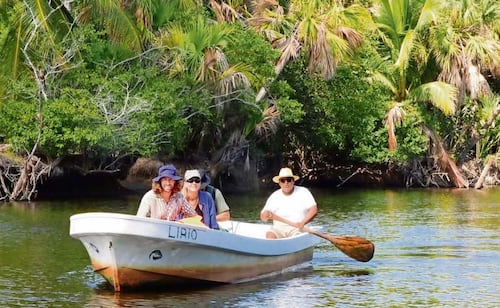
Crocodile care becomes a livelihood in Oaxaca community
Translated from Spanish, summarized and contextualized by DistantNews.
At a glance
News
Named sources
Context piece
- The community of La Ventanilla in Oaxaca, Mexico, has transformed crocodile conservation into a sustainable biocultural tourism model over 30 years.
- Residents shifted from exploiting turtles and crocodiles for skins and meat to becoming protectors of these species and their habitat.
- This model, initiated after a federal ban on turtle and crocodile exploitation in 1990, now provides economic benefits through ecotourism services.
In La Ventanilla, Oaxaca, a community has spent three decades meticulously preserving crocodile sanctuaries, evolving into a model of sustainable biocultural tourism and conservation. This transformation, achieved in collaboration with scientists and specialists, has not only protected the reptiles but also their diverse habitat, which supports hundreds of other flora and fauna species.
José Ernesto Ruiz of the Pitao Peeche Environmental Training Center explains that this initiative emerged as a response to the ban on turtle exploitation. The community transitioned from being predators of turtles and crocodiles, which were once their primary economic activity, to becoming dedicated conservators. In the late 1960s, families settled in La Ventanilla, relying on agriculture, fishing, and selling turtle eggs and hunted animals. A Spanish company even purchased turtles and crocodiles for their skins and meat, making it a significant source of employment.
However, a federal decree in May 1990 imposed a total ban on the exploitation of turtles and crocodiles, significantly impacting the community's main income source. In response, residents developed new economic strategies, offering services like boat tours, palapas, and restaurants to visitors. By 1997, the community formally established itself as a tourist services cooperative with six members.
"The challenge was, if you were a poacher, today you have to convince people that we are going to protect them," recalls Agustín Reyes, from the La Ventanilla Ecotourism Services Cooperative. Sol Guerrero Ortiz, deputy coordinator for scientific authority at Mexico's National Commission for the Knowledge and Use of Biodiversity (Conabio), highlights that the work in La Ventanilla represents a "valuation of resources." This shift occurred by recognizing the intrinsic value of the species and generating cultural and economic value.
DistantNews Editorial
Originally published by El Universal in Spanish. Translated, summarized, and contextualized by our editorial team with added local perspective. Read our editorial standards.
More Stories

From Our Blog

What Press Freedom Means for the News You Read

What Gets Lost (and Found) When News Is Translated

The Critical Role of Diaspora Media in Global News

What Travellers Should Know About Countries with Restricted Press

A Digital Nomad's Guide to Following Local News
