


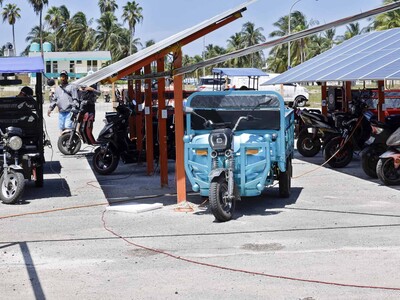
Cuba’s “solineras” offer a new answer to blackouts
Translated from Spanish and summarized by DistantNews. Read the original for the full story.
At a glance
In-depth
Named sources
Ongoing story
- A solar-powered “solinera” at Playa Mégano near Havana charges electric vehicles and household devices during prolonged power cuts.
- Owner Eduardo León says the station can serve up to 60 cars, motorcycles and tricycles daily using solar panels, batteries and inverters.
- The stations have attracted customers and official attention as many Cuban electric vehicles have limited range and residents struggle to charge them at home.
At Eduardo León’s “solinera,” residents have brought more than electric vehicles to charge. A razor, a mobile phone and a rice cooker are among the devices powered at the station, which combines vehicle charging with a community service.
I am solving a need.
León, a 45-year-old lawyer, invested his savings with his wife, Jenifer Arias, to establish the private venture at Playa Mégano, about 30 kilometers from central Havana. The station operates on land leased from the state and uses 24 solar panels, three batteries and inverters, allowing León to charge up to 60 vehicles a day.
About two weeks after opening, León said the business was doing well. He plans to open another station in a nearby Havana municipality and install a wind turbine. The project has also drawn the attention of government officials and state media.
The beach used to be dead.
For electric-vehicle users, the station offers a practical solution. José Enrique García said his motorcycle normally cannot make the round trip to the beach on one charge. While the battery recharges, he and his wife can spend time there before returning home.
I live quite far away, and motorcycles normally cannot get here because they do not have enough charge to return.
Many Cuban vehicles, especially the three-wheeled vehicles common on the streets, have a range of no more than 80 kilometers. With blackouts in Havana lasting more than 20 hours in recent weeks, home charging has become difficult. León’s station charges between $2 and $5 for a full battery, depending on the vehicle’s consumption. Oleisi Leliebre, who learned about the service through social media, called it “a very good innovation.”
It is a very good innovation.
About this summary
Originally published by Diario Libre in Spanish. Translated, summarized, and contextualized automatically by DistantNews, with a note on how the source frames the story. Not individually reviewed before publishing. How this works.
More Stories



From Our Blog

What Gets Lost (and Found) When News Is Translated

The Critical Role of Diaspora Media in Global News

What Travellers Should Know About Countries with Restricted Press

A Digital Nomad's Guide to Following Local News

How the Same Story Looks Different in Different Countries
