


Cutting waste key to economic recovery - Pres Mahama
Summarized and contextualized by DistantNews.
At a glance
News
Sources not specified
Context piece
- Ghanaian President John Dramani Mahama described the nation's economic recovery over the past 18 months as "phenomenal."
- He attributed this progress to fiscal discipline and significant efforts to reduce government waste and unnecessary spending.
- Mahama highlighted plans to invest $2.5 billion annually over four years in seven key sectors, with a focus on agriculture and agro-processing, particularly benefiting the Upper East Region.
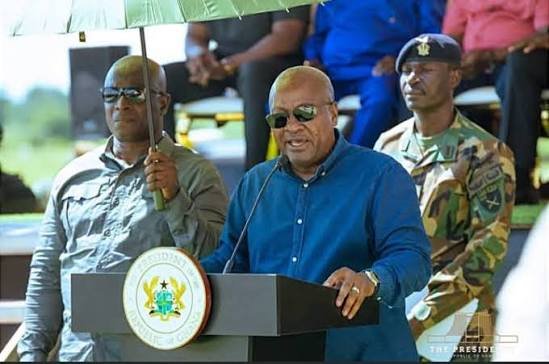
Ghana's economic recovery over the past year and a half has been described as "phenomenal" by President John Dramani Mahama. Speaking during his 'Accounting to the People' tour in Bolgatanga, Mahama attributed this significant progress to the government's commitment to fiscal discipline and deliberate measures to curb waste and reduce unnecessary expenditures.
Cutting down waste and related unnecessary expenditure has helped in this recovery. The whole of last year (2025), we did not send any loan agreement to Parliament. Not even one loan agreement.
"Cutting down waste and related unnecessary expenditure has helped in this recovery. The whole of last year (2025), we did not send any loan agreement to Parliament. Not even one loan agreement," President Mahama stated. He emphasized that the government's prudent economic management and effective utilization of Internally Generated Funds (IGF) have been crucial in financing its programs, relying primarily on its own resources rather than new loans.
The government has only recently submitted loan agreements to Parliament, including a $300 million World Bank STARR-J project aimed at ending the double-track education system and a $500 million Feeder Roads project. Mahama assured that the administration is working towards stabilizing the economy to foster job creation and expand opportunities for the youth.
The first loan agreements that have been sent to Parliament are the $300 million World Bank STARR-J project, which was secured to end the double-track education system, and the $500 million Feeder Roads project.
A key initiative, "The New Economy," will be presented to Parliament by Finance Minister Dr. Cassiel Ato Forson. This policy outlines a plan to invest $2.5 billion annually for the next four years into seven selected economic sectors. Agriculture and agro-processing are identified as the primary beneficiaries, slated to receive 50% of the total $10 billion investment over the period. The Upper East Region is expected to benefit substantially from this focus, with plans to enhance irrigation facilities to support year-round agricultural production.
And every year we are going to, for the next four years, invest $2.5 billion in those seven sectors. But the biggest is agriculture and agro-processing, where the Upper East will benefit a lot from it.
President Mahama also aims to establish the Upper East Region as Ghana's agricultural hub, with accelerated work on the Tomato Revitalization Project and significant progress on the Tamne Irrigation Dam project in Tempane. These efforts are intended to boost tomato production for the domestic market and support five districts and a municipality in the region.
So $5 billion is going to go into agriculture and agro-processing, and I can assure you the Upper East Region is going to get its fair share of that $5 billion, so that we will cover creating more irrigation facilities to ensure our young people, even in the dry season, would have the opportunity to produce.
DistantNews Editorial
Originally published by Ghanaian Times. Summarized and contextualized by our editorial team with added local perspective. Read our editorial standards.
More Stories


From Our Blog

What Gets Lost (and Found) When News Is Translated

The Critical Role of Diaspora Media in Global News

What Travellers Should Know About Countries with Restricted Press

A Digital Nomad's Guide to Following Local News

How the Same Story Looks Different in Different Countries
