


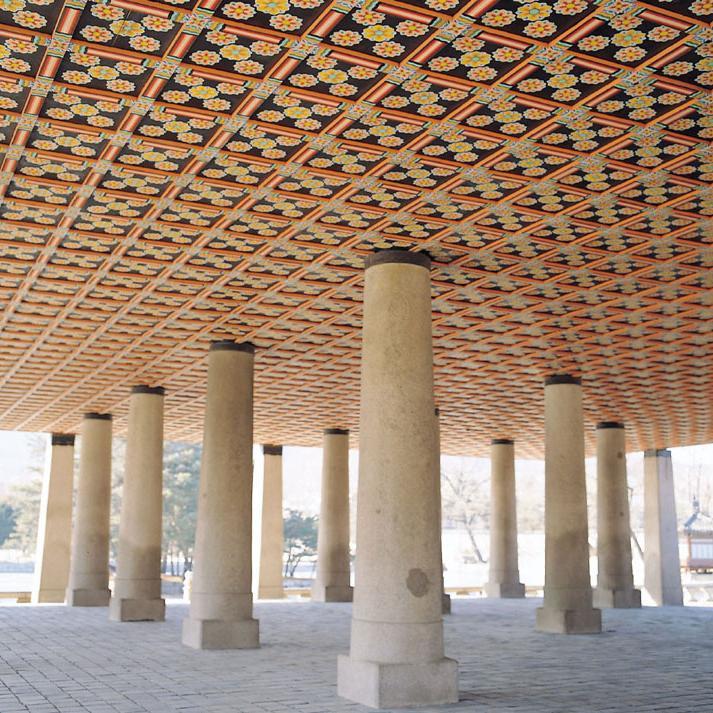
Dancheong: Eastern Worldview Painted in Five Colors
Translated from Korean, summarized and contextualized by DistantNews.
At a glance
In-depth
Sources not specified
Context piece
- Traditional Korean architectural decoration, Dancheong, uses five colors to represent the order of space and time.
- The five colors, derived from the theory of Yin and Yang and the Five Elements, symbolize directions and seasons, reflecting a worldview.
- Dancheong's principles have been reinterpreted in modern design, bridging Korean identity with East Asian universality, as seen in a Michelin-starred restaurant in Hangzhou.
Dancheong, the traditional Korean art of decorating wooden architecture with vibrant colors and patterns, is more than mere ornamentation; it embodies a worldview.
Dancheong is not just for beauty, but an expression of humanity's yearning for the afterlife and origins.
Rooted in the philosophy of Yin and Yang and the Five Elements, Dancheong's core colors, blue, red, yellow, white, and black, represent directions and the passage of time through the sun's movement and the changing seasons. This symbolic language of color, known as Obangsaek, signifies the Eastern perception of space and time. Even the South Korean flag incorporates four of these colors, each carrying symbolic meaning.
Dancheong is a symbol and expression of how the East perceives space and time.
In traditional architecture, principles like "upper green, lower red" mimic nature, creating a sense of stability. The blue of the ceiling visually brightens the interior, while the red of the pillars connects to the earth, grounding the space. This color arrangement also reflects a cyclical understanding of Yin and Yang, with the sky (blue) representing Yin and the earth (red) representing Yang, a reversal that signifies natural harmony.
The visual effect of the green ceiling makes the interior feel bright and clear, and the red color applied to the pillars, similar to the earth, provides a sense of stability.
While Dancheong shares its philosophical underpinnings with Chinese and Japanese traditions, each country has developed unique expressions. Originating in China's Han Dynasty, Dancheong's influence spread to Baekje and Japan. The art form's shared principles have allowed it to serve as a cultural bridge. This is exemplified in the design of a Michelin-starred Korean restaurant in Hangzhou, China, where Dancheong's color principles were reinterpreted to harmonize Korean identity with the existing architecture, demonstrating its enduring relevance as a medium connecting cultures.
Dancheong, through the color and form language of color, captures both Korean identity and East Asian universality.
DistantNews Editorial
Originally published by Dong-A Ilbo in Korean. Translated, summarized, and contextualized by our editorial team with added local perspective. Read our editorial standards.
More Stories



From Our Blog

What Gets Lost (and Found) When News Is Translated

The Critical Role of Diaspora Media in Global News

What Travellers Should Know About Countries with Restricted Press

A Digital Nomad's Guide to Following Local News

How the Same Story Looks Different in Different Countries
