

Dark energy, exoplanets and black holes: What NASA’s new Roman telescope will explore
Translated from English and summarized by DistantNews. Read the original for the full story.
At a glance
News
Named sources
Ongoing story
- NASA launched the Nancy Grace Roman Space Telescope from Florida aboard a SpaceX Falcon Heavy rocket.
- The observatory will travel to the Sun-Earth L2 point and survey the sky with a field of view at least 100 times wider than Hubble’s.
- NASA expects Roman to identify tens of thousands, possibly up to 100,000, new exoplanets while investigating dark matter and dark energy.
NASA’s newest space telescope has begun a three-month journey toward an orbit about one million miles from Earth, carrying a broad search for planets and the forces that shape the universe.
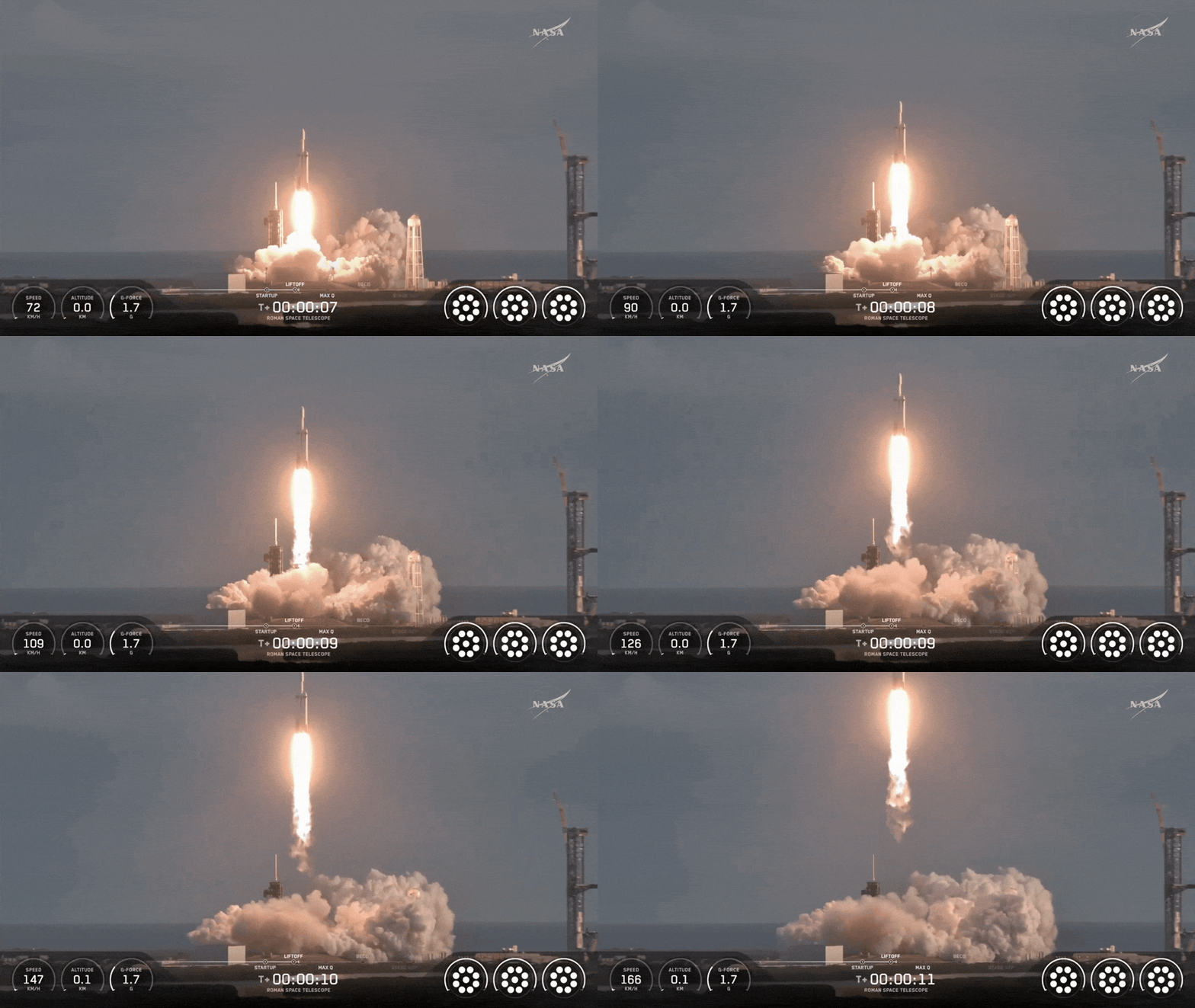
The Nancy Grace Roman Space Telescope lifted off from the Kennedy Space Center in Florida aboard a SpaceX Falcon Heavy rocket. The rocket released the observatory 31 minutes into the flight, sending it toward the second Sun-Earth Lagrange point, known as L2.
Roman is going to change the way we look at the Universe.
Roman’s Wide Field Instrument will let scientists observe a much larger portion of the sky in a single image. NASA says its field of view will be at least 100 times wider than Hubble’s. Its position at L2 will also help its infrared instruments avoid interference from infrared light emitted by the Moon and Earth, astronomer Jenifer Millard told the BBC.
Why do we care so much about exoplanets? Because one of our main goals at NASA is answering the question, ‘Are we alone in the universe?’
Exoplanets are one of Roman’s main targets. NASA administrator Nicky Fox said the telescope could discover tens of thousands, and perhaps as many as 100,000, planets beyond the solar system. The survey will help scientists study distant worlds and assess whether their atmospheres could indicate habitable conditions.
Roman will also investigate dark matter and dark energy, which together are thought to account for about 95% of the universe. Unlike Hubble, which has orbited Earth since 1990, and the James Webb Space Telescope, which operates around L2, Roman is designed to cover a far broader area in each observation.
With Roman, we are going to make this giant leap forward... that is going to allow us to look at these distant, distant worlds and start to really resolve the atmosphere around them to let us know: could they be habitable?
About this summary
Originally published by Times of India in English. Translated, summarized, and contextualized automatically by DistantNews, with a note on how the source frames the story. Not individually reviewed before publishing. How this works.
More Stories



From Our Blog

What Press Freedom Means for the News You Read

What Gets Lost (and Found) When News Is Translated

The Critical Role of Diaspora Media in Global News

What Travellers Should Know About Countries with Restricted Press

A Digital Nomad's Guide to Following Local News
