




“Darkness Over Berlin, Putin’s Supporters Have Won”: Italian Press Reacts to AfD Victory
Translated from Polish and summarized by DistantNews. Read the original for the full story.
At a glance
News
Named sources
Outcome reported
- Italian newspapers reacted sharply to projections showing the AfD winning Saxony-Anhalt’s election with 44 percent of the vote.
- Former Italian prime minister Paolo Gentiloni called the AfD an extremist, strongly pro-Russian party and warned of consequences beyond eastern Germany.
- The coverage framed the result as a test for pro-European forces ahead of elections in several European countries.
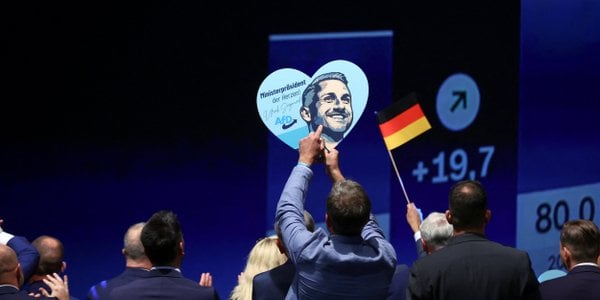
“Darkness over Berlin.” That was the front-page headline chosen by La Repubblica after projections showed the Alternative for Germany, or AfD, winning Sunday’s election in Saxony-Anhalt with 44 percent of the vote.
The newspaper’s commentator wrote that Germany had opened “a worrying new chapter” in its history. Paolo Gentiloni, the former Italian prime minister, foreign minister and European commissioner, described the result in similarly stark terms. “Those who want to end the culture of Holocaust remembrance have won, and that culture underpinned postwar democracy in Germany,” he wrote.
Darkness over Berlin
Gentiloni added: “Nostalgics and Putin supporters have won.” He said the result in Saxony-Anhalt could have consequences extending far beyond eastern Germany. In his view, pro-European forces in Berlin and elsewhere in Europe face two choices: try to contain nationalist extremism by accommodating it, or renew the push for a more integrated and stronger Europe that can respond more effectively to security concerns and public discontent.
Germany opened a new chapter in its history yesterday, and it is a worrying chapter.
He called the AfD “an extremist party whose program includes both the dramatic deportation of immigrants and the absurd removal of wind turbines,” as well as a party “very friendly toward Putin’s Russia.” He also noted that the AfD was leading national opinion polls with support approaching 30 percent.
Gentiloni placed the German vote at the start of a wider European election cycle. Sweden was due to vote on Sept. 13, followed the next year by France, Spain, Greece, Poland and Italy. “The fact that this electoral cycle has begun with a loud signal of far-right extremism puts us at a crossroads,” he wrote.
Those who want to end the culture of Holocaust remembrance have won, and that culture underpinned postwar democracy in Germany.
La Stampa described the result as an “ultra-right avalanche” and said Brussels was worried about Chancellor Friedrich Merz’s future and whether the vote could trigger a domino effect. The paper said the result had sent shivers through the European Union, left Europe in shock and ushered in “a year of fear.” Its editorial called the state election an alarm bell for EU governments, pointing to the victory of a party associated, more or less openly, with the Germany that left behind Hitler, the ruins of war and an indelible responsibility for the Holocaust.
Nostalgics and Putin supporters have won.
About this summary
Originally published by Rzeczpospolita in Polish. Translated, summarized, and contextualized automatically by DistantNews, with a note on how the source frames the story. Not individually reviewed before publishing. How this works.
More Stories

From Our Blog

News in Translation: What Gets Lost, and How We Keep the Framing

Diaspora Media: How Communities Follow News From Home

Traveling Where the Press Is Not Free: How to Read the News There

The Digital Nomad's Guide to Local News

The Same Story, Different Countries: How Coverage Changes at the Border
