


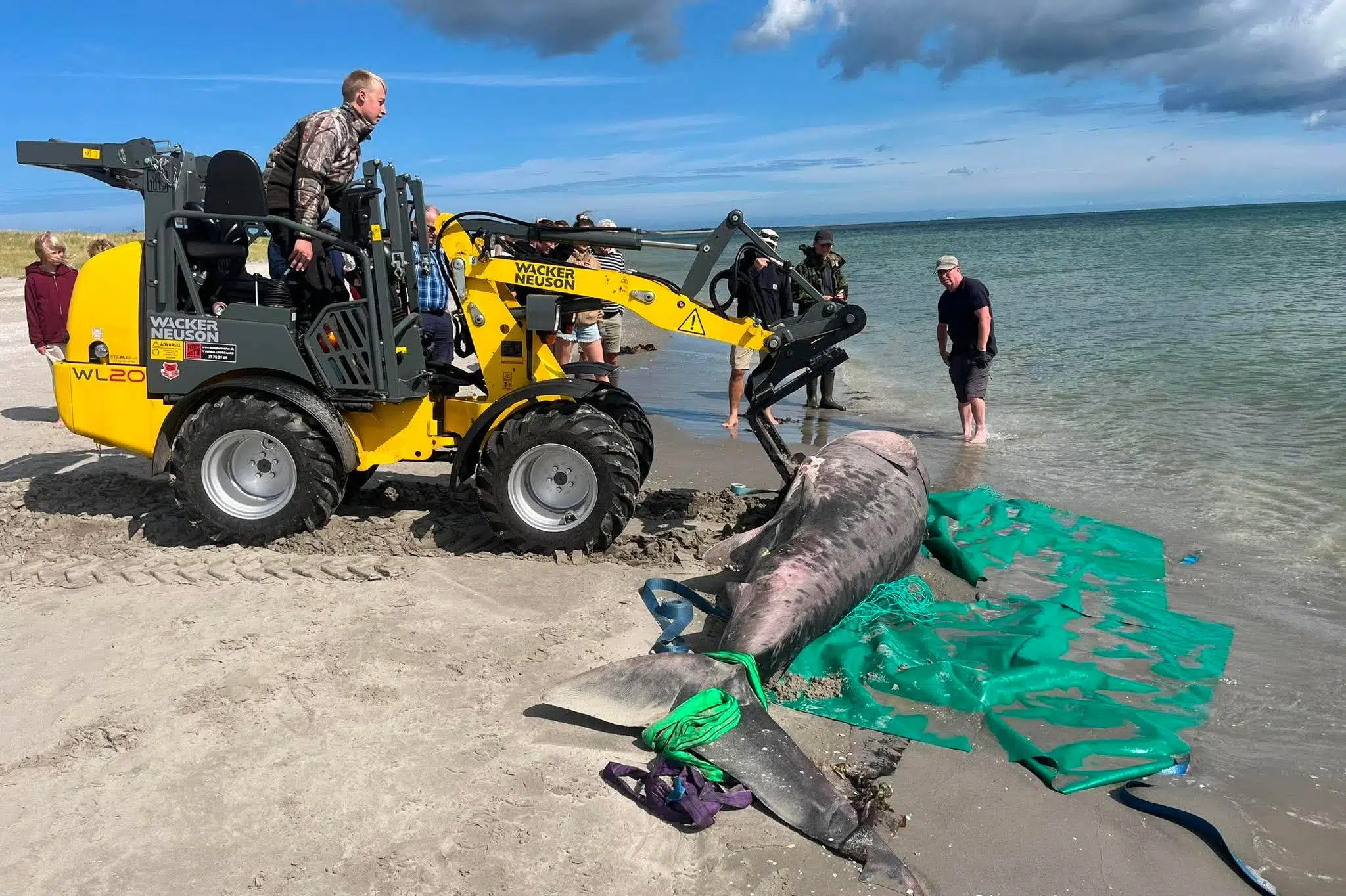
Dead basking shark found with spaghetti-like parasites in its gut
Translated from Danish, summarized and contextualized by DistantNews.
At a glance
News
Sources not specified
Outcome reported
- A nearly five-meter-long basking shark found dead near Ålbæk Harbor contained spaghetti-like parasites in its intestines.
- Researchers believe the parasites did not significantly impact the shark's health, as it had recently eaten plankton and small crustaceans.
- Scientists are conducting further laboratory tests and a CT scan on the shark's head to investigate potential hidden infections.
A large basking shark, measuring nearly five meters and weighing half a ton, was found dead near Ålbæk Harbor in Denmark and revealed to have spaghetti-like parasites in its intestines. Researchers from several Danish institutions, including the Natural History Museum of Denmark and the Nordsøen Oceanarium, performed a dissection on Wednesday.
We found parasites in the shark's intestines – some long spaghetti-like worms. But not to an extent where we suspect it affected or made the shark sick.
While parasites were found, chief biologist Kristina Ydesen from the Nordsøen Oceanarium stated they were not believed to be the cause of death. "We found parasites in the shark's intestines – some long spaghetti-like worms. But not to an extent where we suspect it affected or made the shark sick," Ydesen said.
The shark appeared to be in good condition otherwise, having eaten plankton and small crustaceans within 24 hours of its death. No plastic or foreign objects were found in its stomach. The shark, believed to be a young female not yet sexually mature, is now undergoing further examination, including a CT scan at Aarhus University Hospital, to look for any hidden infections.
We are bursting with curiosity, so we hope to get some answers.
Basking sharks are the second-largest living shark species and can grow over ten meters long. They inhabit oceans like the Atlantic and Pacific and occasionally visit Danish waters, with the last recorded sighting in 2015. The species is protected, and conservation efforts aim to increase their numbers, as populations have previously declined due to fishing.
It used to be a species we had quite a few of, also in inner Danish waters. Now it has become totally protected, and we can only hope that more will come over time.
DistantNews Editorial
Originally published by Berlingske in Danish. Translated, summarized, and contextualized by our editorial team with added local perspective. Read our editorial standards.
More Stories



From Our Blog

What Gets Lost (and Found) When News Is Translated

The Critical Role of Diaspora Media in Global News

What Travellers Should Know About Countries with Restricted Press

A Digital Nomad's Guide to Following Local News

How the Same Story Looks Different in Different Countries
