


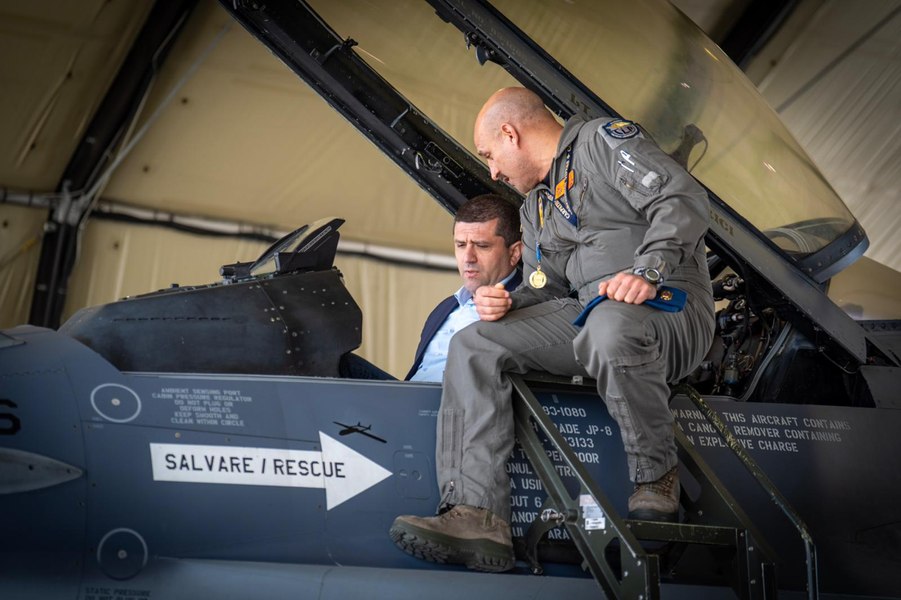
Defense Ministry Clarifies Role in Assault Rifle Project Amidst Conflicting Reports
Translated from Romanian, summarized and contextualized by DistantNews.
At a glance
News
Named sources
Outcome reported
- Reports suggest the Romanian Ministry of Defense initially opposed a new assault rifle project proposed by the Ministry of Interior.
- Despite reported opposition, the project advanced, and after receiving approval from parliamentary defense committees, Minister Radu Miruță praised the initiative as a major achievement.
- The Ministry of Defense issued a statement clarifying its role, emphasizing that its operational requirements were general and aimed to meet the army's needs without favoring specific producers.
Conflicting reports have emerged regarding the development of a new assault rifle project in Romania, with sources indicating initial opposition from the Ministry of National Defense (MApN) to a proposal by the Ministry of Interior (MAI).
In December 2025, the Ministry of National Defense defined and transmitted to the Prime Minister's Chancellery and the Ministry of Economy, Digitization, Entrepreneurship and Tourism the operational requirements related to the armament categories for which the institution is a beneficiary.
According to sources, Minister Radu Miruță and some collaborators within the Ministry of Defense reportedly strongly opposed the SAFE project, which aims to produce a next-generation assault rifle in Romania. However, the project progressed, and following favorable reviews from parliamentary defense committees, Minister Miruță allegedly shifted his stance. In a presentation to lawmakers, he reportedly lauded the initiative as a significant accomplishment, highlighting the capabilities of the Romanian defense industry.
These requirements were approved by the Supervisory Council and remained unchanged throughout the entire duration of the process, not undergoing any modification until the conclusion of the negotiation procedures.
The Ministry of Defense issued a statement on Tuesday to address the public information surrounding the acquisition under the "NATO-type individual armament system" program, financed by the SAFE initiative. The ministry clarified that in December 2025, it defined and transmitted operational requirements for armament categories for which it is a beneficiary. These requirements, approved by the Supervisory Council, remained unchanged throughout the negotiation process.
The operational requirements were formulated exclusively based on the needs of the Romanian Army and were general in nature, so that they could be met by several producers existing on the market.
MApN emphasized that its operational requirements were formulated solely based on the Romanian Army's needs and were general in nature to allow multiple market producers to meet them. The ministry stated that these requirements were not designed around a specific product, manufacturer, or economic operator, and did not restrict competition. The statement also detailed the specific armament categories for which MApN developed and internally approved technical specifications, including pistols, assault rifles, grenade launchers, light support machine guns, and sniper systems. The ministry stressed that these specifications did not reference any particular manufacturer or contain restrictive clauses favoring any specific entity, being based exclusively on military operational necessities. It also noted that certain caliber requirements, such as 4.6 mm and 6.8 mm, were not intended for MApN but for other national defense and security institutions.
These were not built around a specific product, manufacturer, or economic operator and did not have the effect of restricting competition.
DistantNews Editorial
Originally published by Adevărul in Romanian. Translated, summarized, and contextualized by our editorial team with added local perspective. Read our editorial standards.
More Stories


From Our Blog

What Gets Lost (and Found) When News Is Translated

The Critical Role of Diaspora Media in Global News

What Travellers Should Know About Countries with Restricted Press

A Digital Nomad's Guide to Following Local News

How the Same Story Looks Different in Different Countries
