


Democratic Party Leadership Race Heats Up with 2002 Election Disputes
Translated from Korean, summarized and contextualized by DistantNews.
At a glance
News
Named sources
Context piece
- Two leading candidates for the Democratic Party leadership, Jeong Cheong-rae and Kim Min-seok, clashed over Kim's past political actions during the 2002 presidential election.
- Jeong accused Kim of lacking loyalty, referencing Kim's stance during the 2002 presidential candidate consolidation between Roh Moo-hyun and Chung Mong-joon.
- Kim defended his actions, citing advice from former President Kim Dae-jung and emphasizing his return to the party as a prodigal son, while Song Young-gil also recounted his role in the 2002 negotiations.
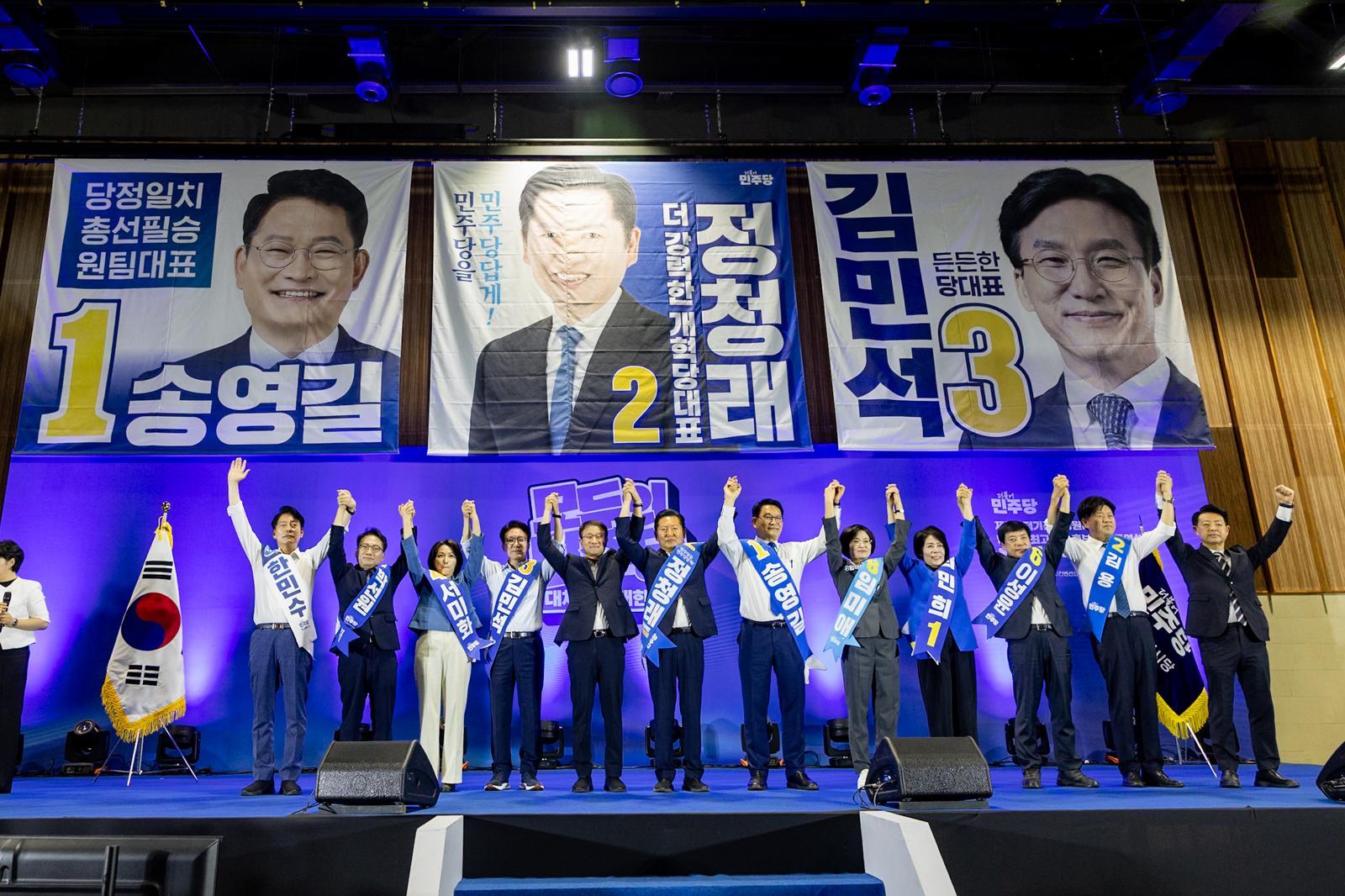
A heated exchange erupted between two contenders for the Democratic Party leadership, Jeong Cheong-rae and Kim Min-seok, during a campaign rally in Busan. The conflict centered on Kim's political maneuvering during the pivotal 2002 presidential election, specifically his actions during the consolidation of candidates Roh Moo-hyun and Chung Mong-joon.
Do you remember the night you were so upset, sending texts and making calls when the Chosun Ilbo editorial said 'Chung Mong-joon abandoned Roh Moo-hyun'? Whose side were you on that night, Kim Min-seok?
Jeong directly challenged Kim's loyalty, recalling a specific night in 2002 when, according to Jeong, Kim reacted strongly to a Chosun Ilbo editorial stating Chung Mong-joon had abandoned Roh Moo-hyun. Jeong questioned whose side Kim was truly on that night, invoking the late President Roh Moo-hyun's emphasis on "loyalty" for being treated with respect. Jeong further criticized Kim for blaming Lee Jae-myung for a past election defeat and then, four years later, attacking Jeong himself, warning that "those who betray once will betray again."
Once a traitor, always a traitor.
Kim Min-seok countered by referencing advice from former President Kim Dae-jung, who reportedly told him to "cultivate inner strength" after the 2002 candidate consolidation. Kim also mentioned that Seo Gap-won, a former lawmaker aware of the 2002 events, is now supporting his campaign. Kim stated that Roh Moo-hyun himself had acknowledged that Kim's actions in 2002 were a result of "historical consolidation by delegates," not a betrayal. Kim expressed gratitude for 24 years of criticism that ultimately led him to realize the power of collective intelligence in politics.
President Kim Dae-jung gave me the topic of 'a veteran cultivating inner strength' after the candidate consolidation.
Kim then declared his return to the party, calling himself "the prodigal son" and "the legitimate son of the Democratic Party," seeking embrace from the party and its members in Busan. Meanwhile, another leadership candidate, Song Young-gil, also weighed in on the 2002 election, recounting his personal efforts to persuade Chung Mong-joon and the subsequent public outrage that he believes helped Roh Moo-hyun win. The exchange highlights the deep historical divisions and ongoing political rivalries within the Democratic Party as it heads into its leadership election.
The prodigal son has returned, embrace him. He is the son of the Democratic Party, the legitimate son.
DistantNews Editorial
Originally published by Hankyoreh in Korean. Translated, summarized, and contextualized by our editorial team with added local perspective. Read our editorial standards.
More Stories


From Our Blog

What Gets Lost (and Found) When News Is Translated

The Critical Role of Diaspora Media in Global News

What Travellers Should Know About Countries with Restricted Press

A Digital Nomad's Guide to Following Local News

How the Same Story Looks Different in Different Countries
