

Do You Know the Witch Riddle?
Translated from Romanian, summarized and contextualized by DistantNews.
At a glance
Analysis
Sources not specified
Context piece
- A hypothetical scenario imagines a powerful witch causing all human-made objects to disappear, leaving only memories.
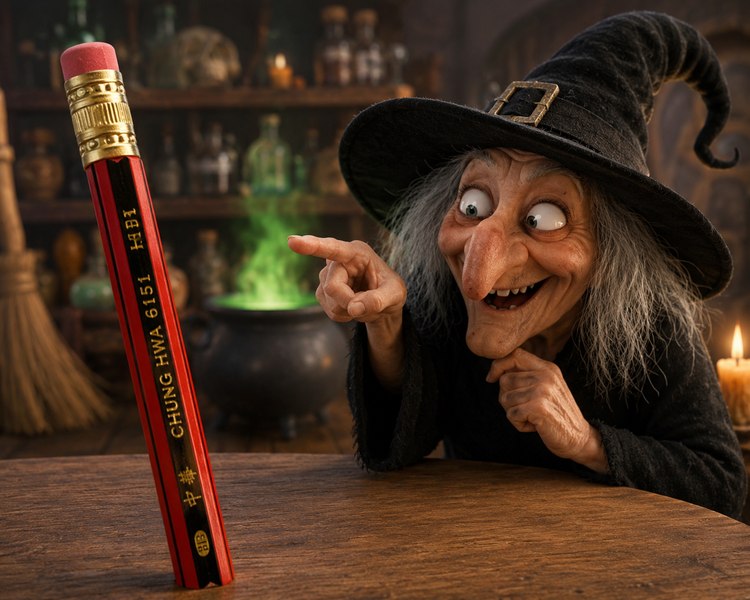
- Humanity's challenge is to perfectly recreate a classic Chinese pencil with an eraser to reverse the spell.
- The article questions how long it would take humanity to achieve this, considering the complexity of modern manufacturing and survival challenges.
Imagine a powerful witch, angered by humanity, casts a spell that instantly erases every object created by human hands. Clothes, cars, buildings, dental implants, roads, orchards, iPhones – everything vanishes. Eight billion people are left naked, but with their memories intact. The witch then offers a counter-spell: if all of humanity can perfectly recreate a classic Chinese pencil with an eraser, identical to an existing one, she will restore everything. The question posed is stark: how long would it take for humanity to achieve this seemingly simple task?
The scenario immediately highlights the fragility of civilization and our deep reliance on manufactured goods. The immediate aftermath would be a brutal struggle for survival. With winter potentially striking in different hemispheres, the survival rate for those left exposed would be grim. Maslow's hierarchy of needs would rapidly take precedence, with hunger, cold, and fear driving immediate priorities. Access to food, shelter, and communication would be paramount, yet entirely absent in their familiar forms.
Recreating even a simple pencil, as the riddle emphasizes, requires an astonishingly complex chain of production. Extracting metal for the ferrule, refining chemicals for the eraser, harvesting and shaping wood, and sourcing and processing graphite are just the initial steps. This requires specialized knowledge across mining, chemistry, forestry, and manufacturing. Furthermore, the riddle specifies an *identical* recreation, demanding precision that is difficult to achieve even with modern technology, let alone in a post-apocalyptic, resource-scarce environment.
The riddle also underscores the breakdown of social order and communication. Even if specialists like engineers, chemists, and loggers survive, they are scattered, naked, and unable to communicate or collaborate effectively. The immediate instinct would be self-preservation, likely leading to widespread conflict over scarce resources. The article suggests that billions would perish within days or weeks, making the organized, collaborative effort needed to produce a pencil virtually impossible in the short term. The witch's challenge, therefore, is not just about manufacturing but about the very possibility of human cooperation and societal rebuilding under extreme duress.
DistantNews Editorial
Originally published by Adevărul in Romanian. Translated, summarized, and contextualized by our editorial team with added local perspective. Read our editorial standards.
More Stories



From Our Blog

What Gets Lost (and Found) When News Is Translated

The Critical Role of Diaspora Media in Global News

What Travellers Should Know About Countries with Restricted Press

A Digital Nomad's Guide to Following Local News

How the Same Story Looks Different in Different Countries
