


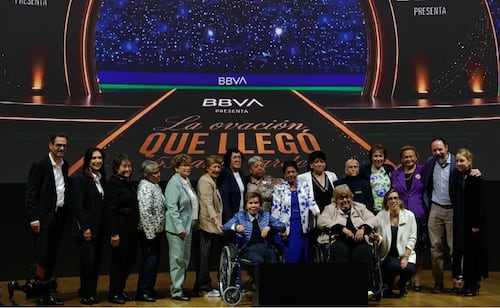
 Image: Fernanda Dávalos | EL UNIVERSAL
Documentary Honors Mexico's 1971 Women's World Cup Runners-Up
Translated from Spanish and summarized by DistantNews. Read the original for the full story.
At a glance
In-depth
Named sources
Context piece
- A new documentary, "The Ovation That Came 55 Years Late," honors Mexico's 1971 Women's World Cup team, who were runners-up despite the tournament not being officially recognized by FIFA.
- The film highlights the legacy of these "Pioneers of '71" and their impact on the professionalization of women's football in Mexico.
- Former players like Martha Coronado and Alicia Vargas shared memories of playing before large crowds at the Estadio Azteca and the challenges they faced without widespread recognition or professional support.
Mexico's history includes four Women's World Cups hosted within its borders, the most recent being the 1971 tournament where the national team achieved a runner-up finish. Despite drawing 110,000 spectators to the Estadio Azteca, this achievement was not officially recorded in FIFA's historical records. The documentary "The Ovation That Came 55 Years Late" now brings the story of these "Pioneers of '71" to light, 55 years after their final match against Denmark.
It is important to recognize the history so that it is not repeated. [...] The conditions have improved infinitely, but there are many gaps that are repeated because football is a reflection of society. [...] The conditions have to be improvable all the time.
Mariana Gutiérrez, president of Liga MX Femenil, emphasized the importance of acknowledging this history to prevent past mistakes. "The conditions have improved infinitely, but many gaps are repeated because football is a reflection of society," she stated. Gutiérrez noted that while professionalization in Mexican women's football has roots in the 1971 team, the journey toward recognition has been long. The team was honored with medals in May during the Clausura 2026 Liga MX Femenil final, signifying a belated acknowledgment of their contributions.
The only thing we wanted was to play our favorite sport: football. To represent Mexico with dignity. With so many people in the stadium, we wanted them to see that women knew how to play football even though we learned in the streets, with our families.
Former player Martha Coronado recalled the team's simple desire: "We just wanted to play our favorite sport: football. To represent Mexico with dignity. With so many people in the stadium, we wanted them to see that women knew how to play football even though we learned in the streets, with our families." This sentiment was echoed by Alicia Vargas, known as the "Mexican Pelé," who remembered the warmth of playing at home despite a lack of footballing recognition. The families of the players often served as their primary sponsors during a difficult era, though they did receive support during the 1971 World Cup.
Nobody knew them football-wise. [...] It was a difficult stage, particularly in the first World Cup in Italy, but she assured that they received support in the 1971 World Cup.
The 1971 Mexican team competed against Argentina, England, Italy, and ultimately lost 3-0 to Denmark in the final on September 5, 1971. Vargas reflected on the current state of professional football, noting the existence of salaries for today's players, a stark contrast to her era. "It's professional football. Little or much they pay them, they already have a salary, unlike us. But it's exciting because, in the end, we would have liked to be in that place," she said. She acknowledged the significant growth of Liga MX Femenil but pointed out the disparity in investment among teams. The documentary will be available through the official channels of Liga MX Femenil and its sponsor BBVA.
It's professional football. Little or much they pay them, they already have a salary, unlike us. But it's exciting because, in the end, we would have liked to be in that place. [...] Liga MX Femenil is growing a lot, but like everything: there are teams that invest in it. There are teams that do not.
About this summary
Originally published by El Universal in Spanish. Translated, summarized, and contextualized automatically by DistantNews, with a note on how the source frames the story. Not individually reviewed before publishing. How this works.
More Stories


From Our Blog

What Press Freedom Means for the News You Read

What Gets Lost (and Found) When News Is Translated

The Critical Role of Diaspora Media in Global News

What Travellers Should Know About Countries with Restricted Press

A Digital Nomad's Guide to Following Local News
