


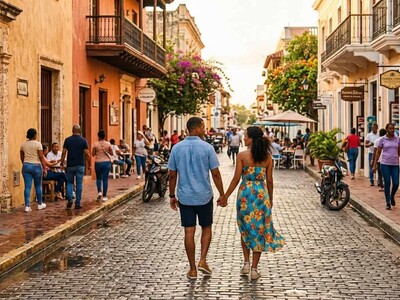
Dominican youth's couplehood evolves with later marriage, more consensual unions
Translated from Spanish, summarized and contextualized by DistantNews.
At a glance
News
Documents & data
Context piece
- Dominican youth transition into couplehood and marriage at different ages and rates than previous generations.
- Data from the National Statistics Office shows women initiate cohabitation and marriage earlier than men.
- Consensual unions become the most common form of partnership for young adults in their mid-twenties.
Young Dominicans are forming couples and families in ways that differ significantly from past generations, with evolving timelines and partnership types. Data from the National Statistics Office (ONE) reveals distinct patterns based on age and gender.
Before age 20, one in five women have already begun a shared life, a rate more than four times higher than for men of the same age. While 80.96% of women under 20 have never married or cohabited, this figure stands at 95.65% for men.
This gap narrows between ages 20 and 24. Here, the proportion of women who have never married or cohabited drops to 44.21%, compared to 70.80% for men. During this period, consensual unions rise, accounting for 35% of women and 19.47% of men. Formal marriages also show a higher prevalence among women (5.59%) than men (2.45%).
By their mid-twenties (25-29), consensual unions become the predominant choice for both genders, with 45.09% of women and 38.35% of men reporting such arrangements. The percentage of those who have never married or cohabited continues to decrease, reaching 31.02% for women and 21.75% for men. Separations from consensual unions also become more common in this age group.
In the 30-35 age bracket, consensual unions remain the most common, with nearly equal proportions for women (45.22%) and men (45.75%). Formal marriage sees a notable increase, particularly among women (18.70% compared to 15.26% for men). Separations from consensual unions continue to rise, indicating more diverse and potentially less stable marital trajectories across Dominican youth.
DistantNews Editorial
Originally published by Diario Libre in Spanish. Translated, summarized, and contextualized by our editorial team with added local perspective. Read our editorial standards.
More Stories

From Our Blog

What Gets Lost (and Found) When News Is Translated

The Critical Role of Diaspora Media in Global News

What Travellers Should Know About Countries with Restricted Press

A Digital Nomad's Guide to Following Local News

How the Same Story Looks Different in Different Countries
