


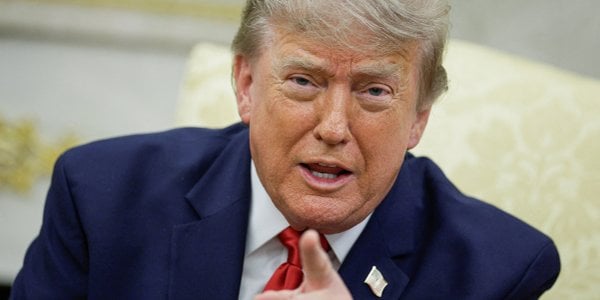
Donald Trump withdraws from Strait of Hormuz fees: 'I don't like the concept'
Translated from Polish, summarized and contextualized by DistantNews.
At a glance
News
Named sources
New plan
- Donald Trump has reversed a decision to impose a 20% fee on ships transiting the Strait of Hormuz.
- The fee was intended as compensation for U.S. security provided for the shipping lane.
- Trump cited a preference for Gulf states investing billions in the U.S. economy instead.
President Donald Trump announced a reversal of a planned 20% fee for vessels passing through the Strait of Hormuz, a move initially conceived as compensation for U.S. security guarantees in the vital waterway. The decision, made just hours before the fee was set to take effect, reflects a shift in strategy driven by alternative proposals from Gulf leaders.
I don't like the concept of charging fees.
During a White House press conference, Trump stated, "I don't like the concept of charging fees." He explained that leaders from several Gulf nations, including kings and emirs, proposed a different approach: "We would prefer to do it differently. We would like to invest billions and billions of dollars in the United States." Trump found this alternative "very satisfying" and considered it an even better solution, indicating that the U.S. would expect greater investment from Gulf states in the American economy in exchange for ensuring maritime security through the Strait of Hormuz.
We would prefer to do it differently. We would like to invest billions and billions of dollars in the United States.
This policy change occurred amidst heightened rhetoric against Iran, with Trump accusing Tehran of initiating military actions and suggesting potential expansions of sanctions. He asserted that U.S. operations had significantly weakened Iran's military capabilities. The proposed fee, estimated to generate around $240 million daily for the U.S., was intended to offset the costs of protecting the shipping route, which is critical for global oil and gas supplies. Prior to the conflict escalation, approximately 20% of the world's oil and gas was transported daily through the Strait of Hormuz, making any disruption a significant factor in global commodity prices and inflation concerns.
It was very satisfying for me. I think it's even a better solution.
The United Nations, through its maritime agency, had previously noted that international law does not provide a basis for unilaterally imposing mandatory transit fees through straits used for international navigation. Trump also reiterated his accusations against Iran, stating, "I wanted to give them a chance to make a deal. But they fired first, and that was a big mistake because we hit them hard. They are very difficult people." He denied regretting any prior temporary easing of sanctions on Iran, maintaining it was an attempt to facilitate a deal.
I wanted to give them a chance to make a deal. But they fired first, and that was a big mistake because we hit them hard. They are very difficult people.
DistantNews Editorial
Originally published by Rzeczpospolita in Polish. Translated, summarized, and contextualized by our editorial team with added local perspective. Read our editorial standards.
More Stories

From Our Blog

What Gets Lost (and Found) When News Is Translated

The Critical Role of Diaspora Media in Global News

What Travellers Should Know About Countries with Restricted Press

A Digital Nomad's Guide to Following Local News

How the Same Story Looks Different in Different Countries
