


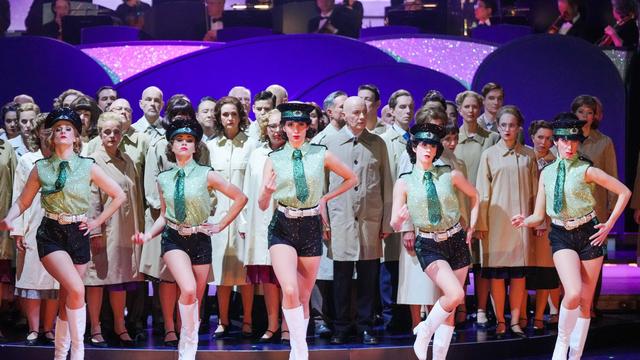
East and West: The GDR as a Revue - does it work?
Translated from German, summarized and contextualized by DistantNews.
At a glance
In-depth
Sources not specified
Context piece
- The Komische Oper in Berlin is staging a musical revue titled "Mokka-Hits und Milchbar-Träume," inspired by East German television.
- Director Axel Ranisch aims to portray the lives of people in the GDR, acknowledging its contradictions without glorifying the system.
- The production features music from various East German artists and aims to resonate with audiences from both former East and West Germany.
Berlin's Komische Oper is presenting "Mokka-Hits und Milchbar-Träume," a new musical revue directed by Axel Ranisch, which reimagines the German Democratic Republic (GDR) as a vibrant stage production. Inspired by the popular East German Saturday evening show "Ein Kessel Buntes," the performance blends catchy Schlager music, a show staircase, and glittering costumes to create an entertaining, and at times reflective, evening.
That was a collective television moment.
Director Ranisch, born in East Berlin in 1983, described watching "Ein Kessel Buntes" with his family as a "collective television moment" from his childhood. His aim with this production is not to idealize the GDR but to acknowledge the lives of the people who lived within its complex system. "It's not about appreciating the system, which absolutely not – but the people who lived in it," Ranisch stated, emphasizing a desire to value the individuals rather than the political structure.
The revue's musical repertoire spans a wide range of artists, from Helga Hahnemann and Karel Gott to Wolf Biermann and Manfred Krug, reflecting the diverse musical landscape of the era. It loosely traces the GDR's history from the post-war period up to shortly after the fall of the Berlin Wall, incorporating cabaret acts from the "Distel" theater.
It's not about appreciating the system, which absolutely not – but the people who lived in it.
Early audience reactions have been positive, with one spectator describing the show as "really good." The production seeks to bridge the divide between East and West Germany, offering a shared cultural experience. Alongside Gisa Flake, Maria-Danaé Bansen, and Thorsten Merten, who previously collaborated with Ranisch, the cast brings to life a nostalgic yet critical portrayal of a bygone era.
Was richtig jut jewesen.
DistantNews Editorial
Originally published by Die Zeit in German. Translated, summarized, and contextualized by our editorial team with added local perspective. Read our editorial standards.
More Stories

From Our Blog

What Gets Lost (and Found) When News Is Translated

How the Same Story Looks Different in Different Countries

The Critical Role of Diaspora Media in Global News

What Travellers Should Know About Countries with Restricted Press

A Digital Nomad's Guide to Following Local News
