

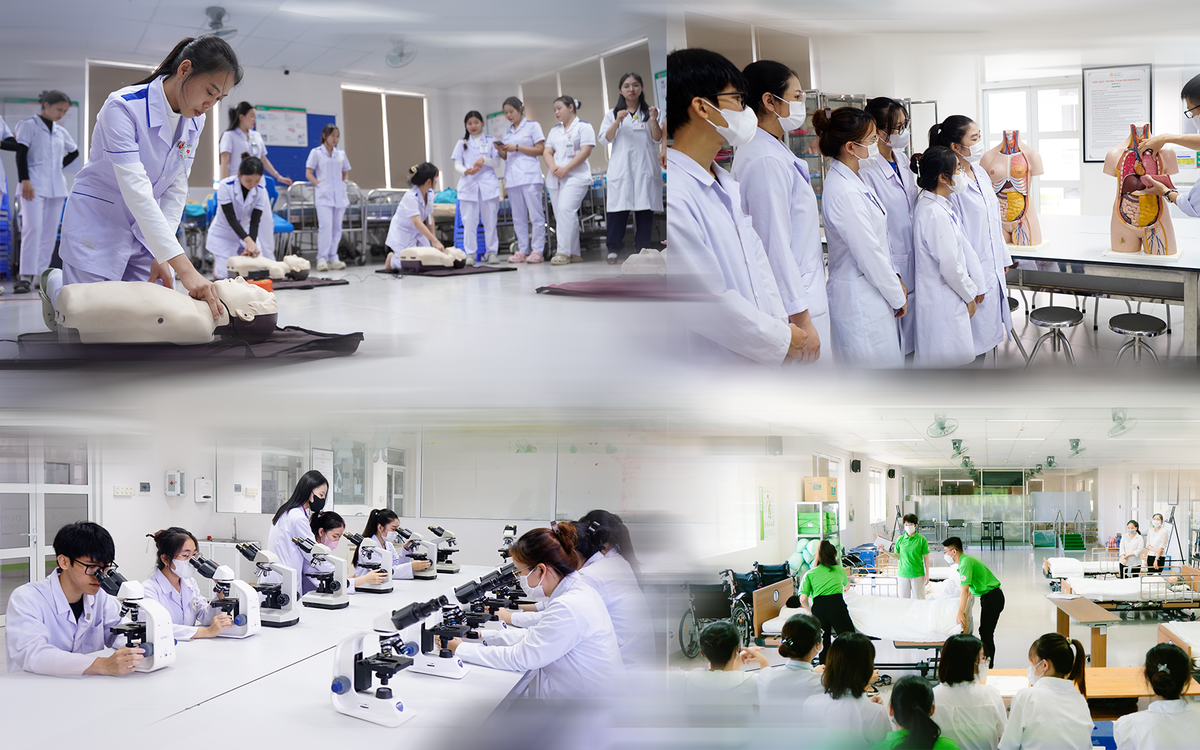
East Asia University Trains Health Students in Clinical Skills and Medical Ethics
Translated from Vietnamese, summarized and contextualized by DistantNews.
At a glance
News
Named sources
Context piece
- East Asia University is training health science students in clinical skills and medical ethics.
- The university's medical program focuses on competency-based education, emphasizing practical skills and professional responsibility.
- A key feature is the "Institute-School" model, linking training with hospitals like Hue Central Hospital for practical experience.
East Asia University is prioritizing the development of clinical competence and medical ethics among its health science students, recognizing the evolving landscape of healthcare driven by technology and artificial intelligence.
The university's general medicine program adopts a competency-based education approach. This model shifts the focus from merely what students learn and for how long, to what they can actually do upon graduation and their professional capabilities. Throughout the six-year program, students undergo continuous competency assessment. This ensures they acquire not only knowledge but also the practical skills, communication abilities, and ethical grounding necessary for patient care.
Students are trained in essential professional tasks, care protocols, patient communication, and situational handling, including patient safety, before direct patient interaction. This rigorous training aims to cultivate a professional demeanor, resilience, and a strong sense of responsibility.
A significant aspect of the university's strategy is its "Institute-School" model, which integrates training with healthcare facilities. East Asia University has established partnerships with hospitals, including Hue Central Hospital and major medical centers in Da Nang. Notably, Hue Central Hospital, one of Vietnam's largest with 5,000 beds, provides students with extensive practical training opportunities. Professors and doctors from the hospital also contribute to the curriculum, offering expertise in clinical practice and research.
Furthermore, the university offers its general medicine program entirely in English, attracting international students, including those from India. This multilingual environment benefits Vietnamese students by enhancing their academic English proficiency, facilitating early access to international medical literature, and fostering cross-cultural professional exchange. The university aims to equip graduates with the necessary skills to excel in the national licensing exams and contribute effectively to the healthcare sector.
Hue Central Hospital currently has the largest number of beds in Vietnam with 5,000 beds, students will have a favorable environment to participate in practice, participate in medical examination work... Based on learning and having practice, it will be the shortest path for students to acquire knowledge and achieve success.
DistantNews Editorial
Originally published by Tuổi Trẻ in Vietnamese. Translated, summarized, and contextualized by our editorial team with added local perspective. Read our editorial standards.
More Stories

From Our Blog

What Gets Lost (and Found) When News Is Translated

The Critical Role of Diaspora Media in Global News

What Travellers Should Know About Countries with Restricted Press

A Digital Nomad's Guide to Following Local News

How the Same Story Looks Different in Different Countries
