


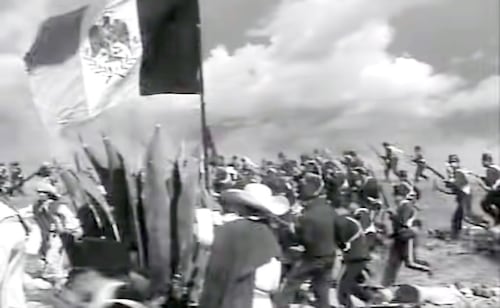

“El desaire,” a film that challenges violence
Translated from Spanish and summarized by DistantNews. Read the original for the full story.
At a glance
In-depth
Named sources
Context piece
- “El desaire,” directed by Gabo Ramos, adapts the well-known “Rosita Alvírez” corrido into a contemporary story about violence against women.
- The film follows Rosa as she confronts a jealous boyfriend and a young harasser, while challenging the song's portrayal of the victim as responsible for her death.
- The production was filmed in Saltillo with a budget of 14 million pesos and received audience awards in the United States, France and India.
For filmmaker Gabo Ramos, violence became impossible to accept as his daughters grew up. He wanted them to understand that if a man subjected them to physical or verbal aggression, they should not submit and should get away. His film, El desaire, grew from that lesson.
It was about seeing where the limits of love are, and my daughters, who were 14 and 12 at the time, were an important driving force.
The movie reworks the famous corrido about Rosita Alvírez, in which a woman is blamed for her own death after rejecting a man who asks her to dance. The contemporary story follows Rosa, played by Vico Escorcia, alongside a jealous boyfriend played by Guillermo Alonso and a young harasser played by Joshua Okamoto.
“It was about seeing where the limits of love are, and my daughters, who were 14 and 12 at the time, were an important driving force,” Ramos said. He criticized the continued popularity of the song, which has been sung proudly for decades despite presenting the victim as responsible for what happened to her.
People have been singing this corrido proudly for decades, but they should not. The song is almost 100 years old and unfortunately this is still happening, things are still the same.
The screenplay was written by two women and two men, including Ramos. He said that process gave the film a stronger perspective on the events. Audiences in the United States, France and India have responded positively and awarded the film audience prizes. Ramos described the question-and-answer sessions as a kind of group therapy, as people discuss what they have experienced or witnessed.
In the end it becomes a kind of group therapy, because people get deeply involved with the subject and bring out everything they have experienced or seen during the question-and-answer sessions.
Produced by Epic Film Institute, Universidad Carolina and Vanguardia, the film was shot in Saltillo, Coahuila, in late 2024 and early 2025. It cost 14 million pesos and is the first film from the university's film institute, which says it defends people's rights and freedom. Ramos's daughters accompanied him throughout filming and also sang on the closing-credits song. In the best-known version of the original corrido, popularized by Antonio Aguilar, the singer says the victim herself was to blame.
It was very important to me that they knew that what is shown in the film is very wrong.
About this summary
Originally published by El Universal in Spanish. Translated, summarized, and contextualized automatically by DistantNews, with a note on how the source frames the story. Not individually reviewed before publishing. How this works.
More Stories
From Our Blog

What Press Freedom Means for the News You Read

News in Translation: What Gets Lost, and How We Keep the Framing

Diaspora Media: How Communities Follow News From Home

Traveling Where the Press Is Not Free: How to Read the News There

The Digital Nomad's Guide to Local News
