


Elon Musk's Rocket Stage May Hit the Moon
Translated from Polish, summarized and contextualized by DistantNews.
At a glance
News
Documents & data
Context piece
- A spent Falcon 9 rocket stage is predicted to impact the Moon on August 5, 2025, near the Einstein crater.
- This rocket stage, launched in September 2025, was not regularly tracked as it remained in deep space after its mission.
- Scientists hope the impact will provide new data on lunar surface interactions and highlight the risks of space debris.
A nearly 4-meter diameter section of a Falcon 9 rocket is on a collision course with the Moon, with impact expected on August 5, 2025, around 8:35 a.m. Polish time. The booster is predicted to strike the lunar surface near the Einstein crater at a speed of 2.43 km/s.
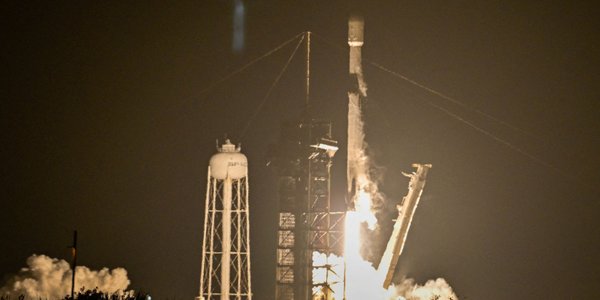
This upper stage of the Falcon 9 rocket was part of a mission that launched two lunar landers on September 15, 2025: Firefly's Blue Ghost-1 and ispace's Hakuto-R Mission 2. While the American lander successfully touched down on March 2, 2025, the Japanese lander entered lunar orbit on May 6 but failed to land, crashing onto the surface.
The rocket stage has been in space since its launch and was not closely monitored by typical satellite and space debris tracking systems, which focus on Earth orbit. However, asteroid-tracking surveys and amateur astronomers with advanced equipment have observed it, allowing for orbital calculations.
Scientists anticipate the impact may create a brief flash of light and eject a significant amount of regolith and dust. Researchers, including those from Los Alamos National Laboratory, NASA, and other international institutions, have published their findings on arXiv.org, an open-access scientific repository. They are appealing for observations of the event, believing it could yield new insights into lunar surface dynamics following an impact and underscore the dangers posed by stray space debris.
Several large telescopes, including the European Southern Observatory's VLT, have reserved observation time. Community science projects like Impact Flash! and the Lunar Impact Flash Network are coordinating efforts, and amateur astronomers are encouraged to participate in observing the event.
DistantNews Editorial
Originally published by Rzeczpospolita in Polish. Translated, summarized, and contextualized by our editorial team with added local perspective. Read our editorial standards.
More Stories



From Our Blog

What Gets Lost (and Found) When News Is Translated

The Critical Role of Diaspora Media in Global News

What Travellers Should Know About Countries with Restricted Press

A Digital Nomad's Guide to Following Local News

How the Same Story Looks Different in Different Countries
