


Enrollment Decline Spurs 'Engineering Conversion' Rush: 104 Single-Sex Schools Down in 5 Years
Translated from Korean, summarized and contextualized by DistantNews.
At a glance
News
Documents & data
Context piece
- South Korean middle and high schools are increasingly transitioning from single-sex to co-educational institutions due to declining student enrollment.
- Over the past five years, the number of single-sex middle and high schools has decreased by 6.8%, with 104 fewer schools operating.
- This trend is also affecting universities, with some women's universities planning to admit male students to ensure their viability amidst demographic shifts.
South Korea is witnessing a significant shift as single-sex middle and high schools increasingly adopt co-educational models in response to declining student populations. Over the last five years, the number of single-sex middle and high schools nationwide has dropped by 6.8%, totaling 104 fewer institutions.
Data indicates that as of 2025, one in every four middle and high schools in South Korea operates as a single-sex institution. Last year, out of 5,679 middle and high schools, 1,418 (25.0%) were single-sex, comprising 630 middle schools and 788 high schools. This marks a decrease from 1,522 single-sex schools in 2021. In contrast, the total number of middle and high schools nationwide saw a slight increase of 59 schools (1.0%) from 2021 to 2025.
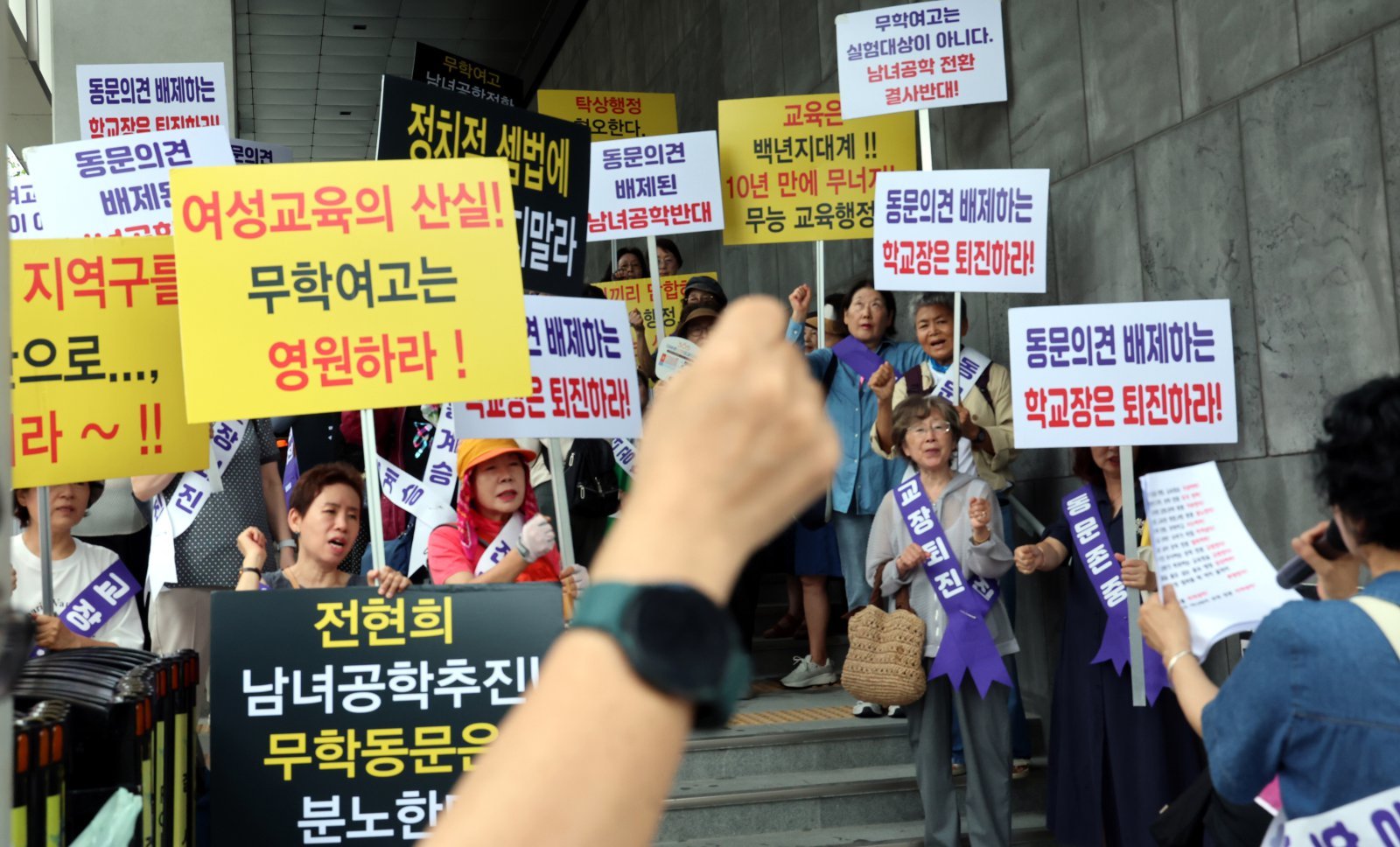
In Seoul, over a third of middle and high schools (32.6%, or 231 schools) are single-sex, with the majority being private institutions. Approximately 89.5% of single-sex middle schools and 85.6% of single-sex high schools in Seoul are privately managed. Eight single-sex middle and high schools in Seoul are scheduled to transition to co-education in the upcoming academic years of 2027 and 2028. This includes prominent schools like Sungsim Girls' High School, former President Park Geun-hye's alma mater, and Muhak Girls' High School, whose alumni strongly opposed the change.
The underlying cause for this trend is the shrinking school-age population, which makes maintaining adequate school sizes and implementing the high school credit system challenging. Nationwide, the number of elementary, middle, and high school students decreased by approximately 310,000 from 2021 to last year. This demographic pressure is also influencing higher education, with some universities, including Dongduk Women's University, planning to transition to co-education and potentially change their names to attract a broader student base. Following Dongduk's planned transition in 2029, only six women's universities will remain among the four-year institutions in South Korea.
The Muhak Girls' High School Co-education Opposition Emergency Committee is holding a press conference opposing the transition of Muhak Girls' High School to co-education.
DistantNews Editorial
Originally published by Dong-A Ilbo in Korean. Translated, summarized, and contextualized by our editorial team with added local perspective. Read our editorial standards.
More Stories


From Our Blog

What Gets Lost (and Found) When News Is Translated

The Critical Role of Diaspora Media in Global News

What Travellers Should Know About Countries with Restricted Press

A Digital Nomad's Guide to Following Local News

How the Same Story Looks Different in Different Countries
