

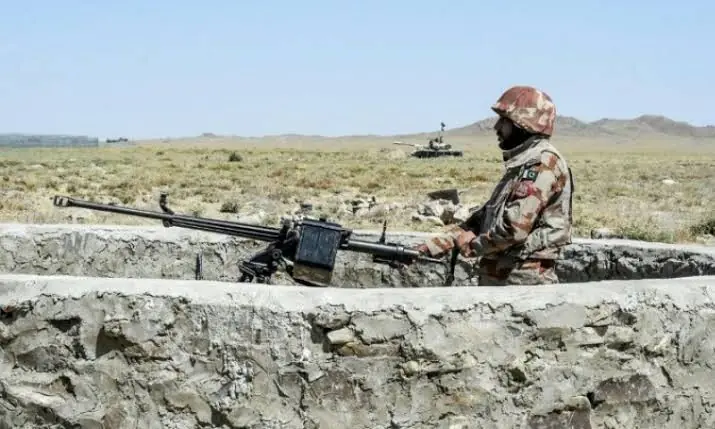
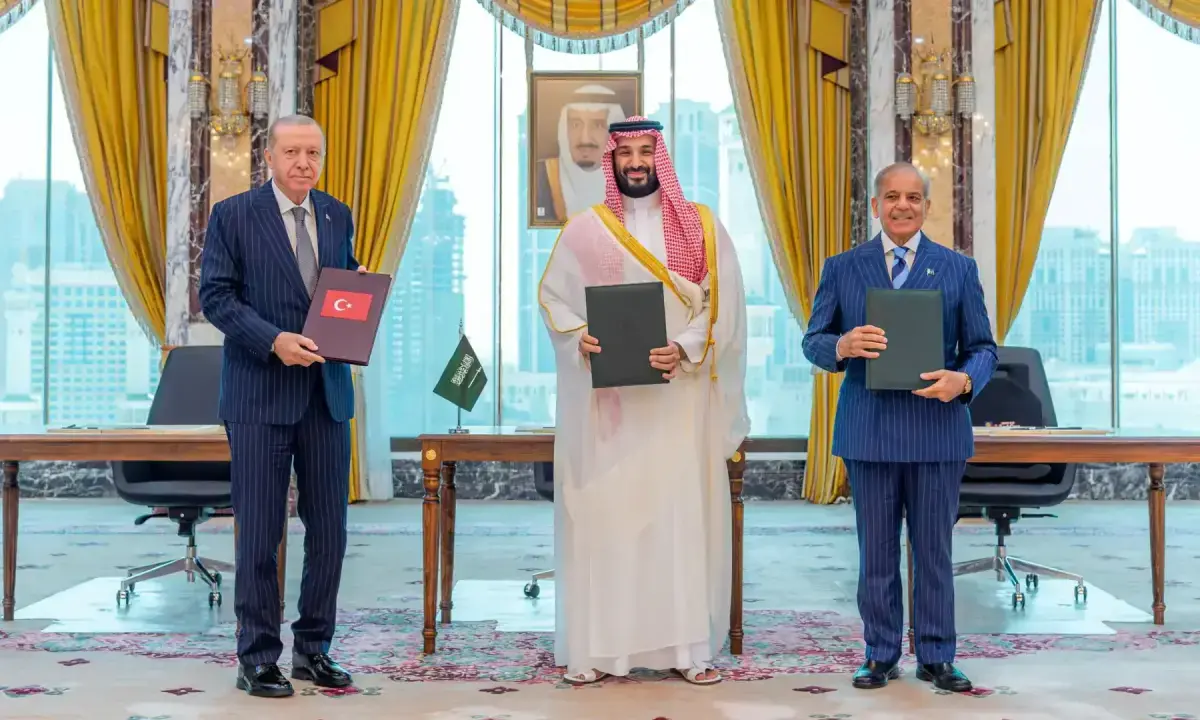
Erdogan eyes expansion of Makkah Joint Defence Agreement, hopes for more members
Translated from English, summarized and contextualized by DistantNews.
At a glance
News
Named sources
Context piece
- Turkish President Erdogan hopes more countries will join the Makkah Joint Defence Agreement, signed by Turkiye, Saudi Arabia, and Pakistan.
- The agreement aims to stabilize a region impacted by the US-Iran war and aims for regional players to take more responsibility for security.
- Turkey expects Egypt to join soon, though Cairo has not commented, while Iran has expressed a positive stance on regional security cooperation.
Turkish President Recep Tayyip Erdogan expressed his aspiration for the Makkah Joint Defence Agreement to expand beyond its initial signatories: Turkiye, Saudi Arabia, and Pakistan. Signed last week, the pact aims to foster regional stability amidst the ongoing US-Iran conflict, which has disrupted crucial shipping lanes.
Our vision for it is not limited to the three countries. Rather we aspire for it to grow, and perhaps appropriate conditions will emerge one day for all countries of the region to gather under its umbrella.
"Our vision for it is not limited to the three countries," Erdogan told the London-based Asharq Al-Awsat daily. "Rather we aspire for it to grow, and perhaps appropriate conditions will emerge one day for all countries of the region to gather under its umbrella." He emphasized that regional issues should be resolved by regional actors, viewing the agreement as a first step toward this goal, and cautioned against externally imposed solutions.
Regional issues should be resolved by regional actors, and with this action, we consider that we have taken a first step toward achieving that goal.
Turkish Foreign Minister Hakan Fidan indicated that Egypt is expected to join the pact in the "next stage," citing only "a few technical issues" as obstacles. Fidan is scheduled to visit Cairo soon, though Egypt has remained silent on the potential accession. The agreement includes a NATO-style mutual defense clause, stipulating that an attack on one signatory is considered an attack on all.
Resolving regional issues must be carried out away from formulas imposed from the outside. We know very well that solutions imported from abroad only bring disasters.
The pact emerges in response to the "new circumstances" in the Middle East, prompting regional players to assume greater security responsibility. The 57-member Organisation of Islamic Cooperation (OIC) has lauded the agreement as a "significant strategic step." Iran has also adopted a positive tone, stressing its commitment to "security mechanisms based on cooperation between regional countries." Pakistan's Prime Minister Shehbaz Sharif affirmed the pact's defensive nature, aimed at promoting "peace, progress, and prosperity in the region."
in the next stage
DistantNews Editorial
Originally published by Dawn in English. Translated, summarized, and contextualized by our editorial team with added local perspective. Read our editorial standards.
More Stories
From Our Blog

What Gets Lost (and Found) When News Is Translated

The Critical Role of Diaspora Media in Global News

What Travellers Should Know About Countries with Restricted Press

A Digital Nomad's Guide to Following Local News

How the Same Story Looks Different in Different Countries
