

EU leaders welcome US-Iran peace talks, urge Hormuz reopening
Translated from English, summarized and contextualized by DistantNews.
At a glance
News
Named sources
New plan
- EU leaders welcomed a peace agreement between the US and Iran, urging its swift implementation.
- They called for the reopening of the Strait of Hormuz, essential for global trade and regional stability.
- Concerns were raised about weaponized energy dependencies, prompting calls for supply chain diversification.
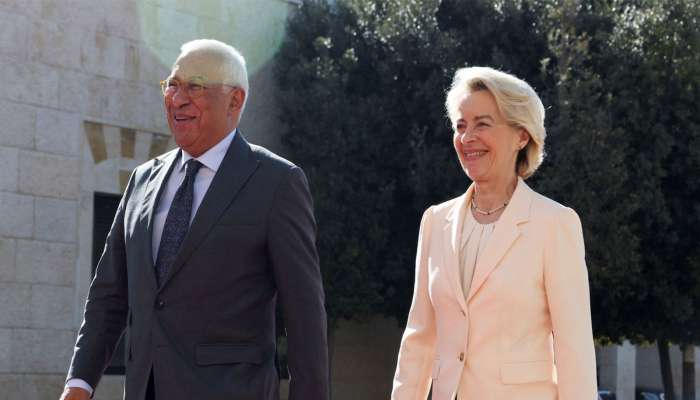
European Union leaders have welcomed a landmark peace agreement between the United States and Iran, describing it as a crucial diplomatic opening for West Asia. European Commission President Ursula von der Leyen and European Council President Antonio Costa both urged the swift and full implementation of the deal.
This is essential for regional stability and the global economy. It opens the door to broader negotiations on peace and security in the Middle East.
Von der Leyen emphasized the importance of immediately reopening the Strait of Hormuz, calling it "essential for regional stability and the global economy." She also urged an end to "Iran's nuclear and ballistic programmes and its destabilising activities in the region." Costa echoed the call for peaceful resolution of differences in accordance with international law, stating the EU is ready to help advance a comprehensive strategy for lasting peace in the Middle East.
Once again, energy dependencies have been weaponised. We must diversify our supply routes and develop alternative export corridors to diversify away from the bottleneck of Hormuz. We will discuss this, and more, in Evian.
The EU leaders also addressed concerns about the weaponization of energy dependencies, particularly in light of recent global events. They called for diversification of supply routes and the development of alternative export corridors to reduce reliance on chokepoints like Hormuz. These issues are slated for discussion at the upcoming G7 Summit in Evian, where leaders will meet with partners from the Gulf and the wider Middle East.
The European Union is ready to contribute to advancing a comprehensive strategy for lasting peace across the Middle East.
Japan's Foreign Minister Toshimitsu Motegi also welcomed the diplomatic resolution, highlighting Japan's consistent efforts towards de-escalation. He reiterated Japan's request for Iran to ensure free and safe navigation through the Strait of Hormuz, a vital artery for global logistics. The agreement is seen as a significant step towards restoring stability, easing pressure on global energy markets, and potentially creating momentum for resolving concerns over Tehran's nuclear program.
Japan has been making proactive diplomatic efforts based on its consistent position that what matters most is that de-escalation of the situation is steadily achieved as soon as possible.
DistantNews Editorial
Originally published by Times of Oman in English. Translated, summarized, and contextualized by our editorial team with added local perspective. Read our editorial standards.
More Stories
From Our Blog

What Gets Lost (and Found) When News Is Translated

The Critical Role of Diaspora Media in Global News

What Travellers Should Know About Countries with Restricted Press

A Digital Nomad's Guide to Following Local News

How the Same Story Looks Different in Different Countries
