

Europe faces worst-ever wildfires as climate models predict longer, more intense fire seasons
Translated from Spanish, summarized and contextualized by DistantNews.
At a glance
News
Named sources
Context piece
- Europe faces increasingly frequent and intense wildfires, with projections indicating a significant rise in high-risk days due to global warming.
- Even under optimistic warming scenarios, southern and central Europe will experience longer fire seasons, with a 3-degree Celsius rise potentially leading to months of fire risk.
- International aid organizations and political groups are calling for sustained investment in climate adaptation and stronger political ambition to combat the escalating crisis.
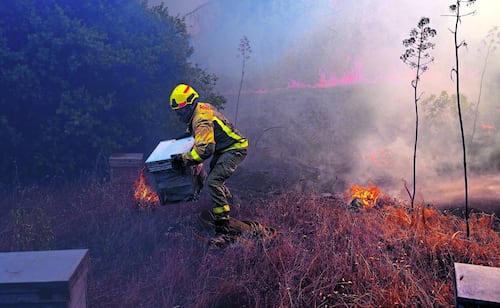
Wildfires are scorching Europe with unprecedented intensity and frequency, prompting dire warnings and urgent calls for action. In Spain's Ávila province, a blaze is dubbed the "fire of the century," while in France's Landes region, residents compare the devastation to the aftermath of World War II.
This is the pattern that we observe with increasing frequency across Europe: heatwaves, droughts, and wildfires feeding each other, and communities suffering the consequences.
The crisis extends beyond traditional fire zones. Even the Netherlands, a nation accustomed to rain, is experiencing more frequent wildfire alerts due to persistent heatwaves. European Environment Agency data suggests a grim future: even if global warming is limited to 1.5 degrees Celsius, fire risk days will increase significantly in southern Europe, Turkey, and Greece, with notable rises also expected in Italy, Hungary, and central France. Projections show a potential increase in fire risk days across central and northern Europe as well.
A more severe warming scenario of 3 degrees Celsius paints an even starker picture. The Mediterranean region and Turkey could face two to five weeks more wildfire risk annually compared to the 1991-2020 period. Large parts of the Iberian Peninsula, Turkey, and southern Greece might endure up to four months of fire-conducive conditions each year. The International Federation of the Red Cross highlights the escalating cycle of heatwaves, droughts, and fires, emphasizing the need for sustained investment in climate adaptation alongside immediate emergency response.
The Red Cross is responding to immediate emergencies, but we also need sustained investment in preparedness and adaptation to climate change, so that communities are better prepared to cope with future crises.
Political leaders are also sounding the alarm. Terry Reintke, co-chair of the Greens/EFA group in the European Parliament, stated that "Europe is burning" due to years of political inaction and weakened climate ambition. She criticized the current situation, where people are forced from their homes and endure unbearable heat, as a direct consequence of insufficient political will.
Europe is burning, people are being forced to leave their homes, and millions of people are suffering unbearable heat, as a result of years of political inaction and weakened climate ambition.
DistantNews Editorial
Originally published by El Universal in Spanish. Translated, summarized, and contextualized by our editorial team with added local perspective. Read our editorial standards.
More Stories
From Our Blog

What Press Freedom Means for the News You Read

What Gets Lost (and Found) When News Is Translated

The Critical Role of Diaspora Media in Global News

What Travellers Should Know About Countries with Restricted Press

A Digital Nomad's Guide to Following Local News
