


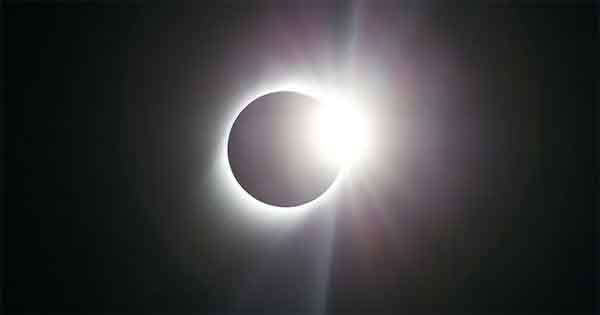
Europe to Witness Total Solar Eclipse in 2026 After 27 Years
Translated from Sinhala, summarized and contextualized by DistantNews.
At a glance
News
Sources not specified
Context piece
- Europeans will witness a total solar eclipse on August 12, 2026, the first in 27 years.
- The eclipse will be visible in parts of Russia, Greenland, Iceland, Spain, and Portugal, with partial views in Western Europe, Northwest Africa, Canada, and the northern U.S.
- NASA highlights a unique solar corona visible during the eclipse, influenced by the solar cycle and magnetic field variations.
For the first time in 27 years, Europe will experience a total solar eclipse on August 12, 2026. An estimated 15 million people across the continent will have the opportunity to witness this celestial event. The eclipse is set to begin at 15:34 GMT, with totality lasting for 2 minutes and 18 seconds.
The eclipse will begin at 15:34 GMT.
Regions including northern Russia, Greenland, Iceland, Spain, and parts of Portugal will see the total eclipse. Other areas such as Western Europe, Northwest Africa, much of Canada, and the northern United States will experience a partial eclipse. NASA has noted that Reykjavik, Iceland, will offer particularly clear views of the phenomenon.
A solar eclipse occurs when the Moon passes between the Sun and Earth, casting a shadow on our planet. During a total eclipse, the Sun, Moon, and Earth align perfectly, temporarily blocking sunlight and darkening the sky in affected areas.
The total solar eclipse will last for 2 minutes and 18 seconds.
This particular eclipse is anticipated to showcase a unique solar corona, a rare sight not seen before and unlikely to be observed again. The corona, the outermost layer of the Sun's atmosphere, is composed of extremely hot gases and plasma. Normally invisible due to the Sun's intense glare, it appears as a silvery or white halo during a total eclipse. The corona's shape constantly changes due to variations in the Sun's magnetic field and plasma flows, with temperatures reaching millions of degrees Celsius.
This solar eclipse is said to feature a unique solar corona that has never been seen before and will not be seen again in the future.
Occurring about two years after the peak of the 11-year solar cycle in October 2024, this eclipse is expected to feature a more active and transitional corona than those seen in 2017 or 2020. NASA predicts that observers will see not only the white coronal rays but also pinkish plasma flares. Adding to the spectacle, six planets, Mercury, Mars, Jupiter, Saturn, Uranus, and Neptune, will align in a single line in the sky during the eclipse.
The solar corona is the outermost layer of the Sun's atmosphere, composed of extremely hot gases and plasma.
DistantNews Editorial
Originally published by Lankadeepa in Sinhala. Translated, summarized, and contextualized by our editorial team with added local perspective. Read our editorial standards.
More Stories



From Our Blog

What Gets Lost (and Found) When News Is Translated

The Critical Role of Diaspora Media in Global News

What Travellers Should Know About Countries with Restricted Press

A Digital Nomad's Guide to Following Local News

How the Same Story Looks Different in Different Countries
